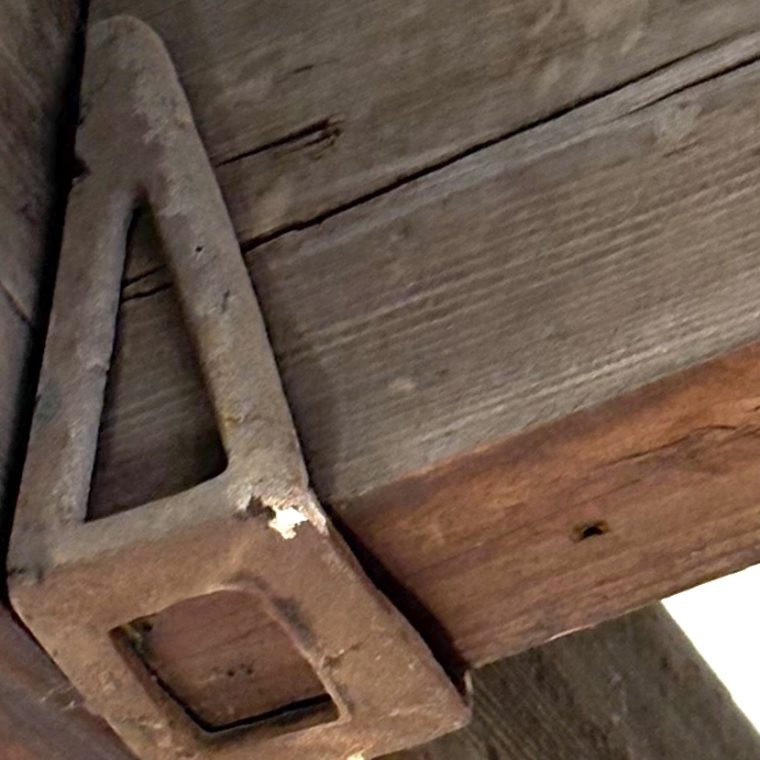

The traditional way to have one wood beam carry another one in the same plane is a mortise-and-tenon connection, which is literally thousands of years old. As long as only wood is going to be used to make the connection, that’s about as good as it gets.1 At some point – my guess is the nineteenth century, but I’m sure there are people who know better than me – people started to use bridle irons. That got rid of the damaging cuts to both beams, but added the complexity of needing a reasonably-skilled blacksmith. If you had heavily-loaded beams and the smith was available, bridles improved your structure.
Bridle irons are too expensive, relatively, to make sense to use on every joist. As a result I’ve seen a lot of nineteenth-century buildings where joist-to-header connections are mortise-and-tenon, while the heavy header-to-trimmer connections are bridles. In the 1890s (I think) people started playing around with lightweight, mass-produced substitutes for bridles. That eventually led to light-gage steel joist hangers as we know them today, but it took a few iterations to get to sheet-metal. Here’s an example from the 1910s, much heavier than the 18-gage or so metal used today, but definitely mass-produced and looking pretty easy to install:

- If the wood has been pre-dried so that you won’t get appreciable shrinkage, a ship-lap might theoretically be better, where the tab on the carried beam transmits the compression on the top side of the carrying beam, but that’s a big, big “if.” ↩︎


You must be logged in to post a comment.