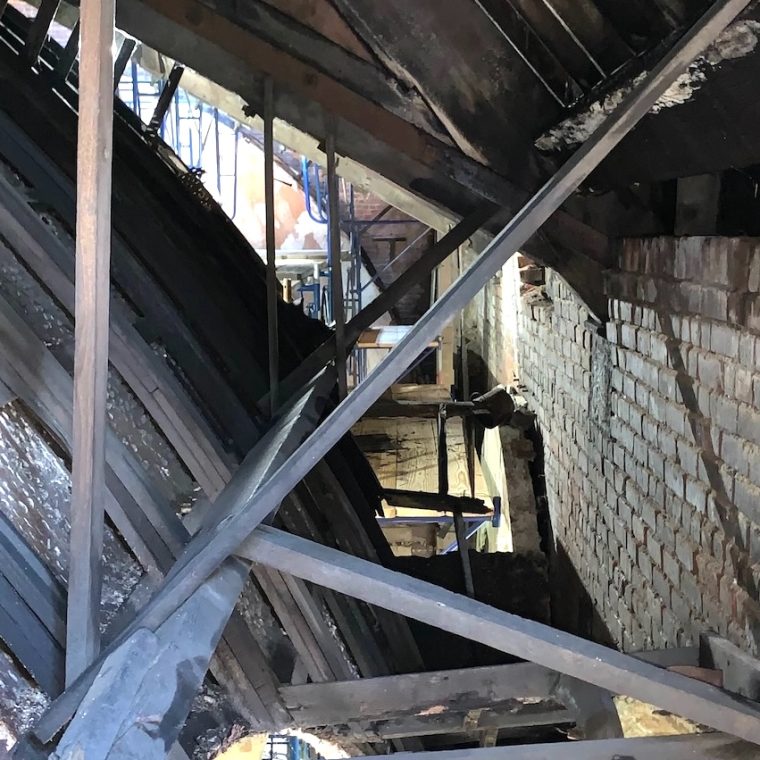

A look inside an 1890s church:

Obviously, we’d be happier if the building were not so damaged, but the state of disrepair means that the way the construction works is more visible and much clearer than it ordinarily is. I mean, isn’t that photo crystal clear?
Here’s some explanation. Ellen took the picture while standing on scaffold that fills the sanctuary, with a portion of the platform visible on the left. The brick wall to the right is the exterior of the building, with a window in the lower right. For everything else, here’s a labelled version:

A is the back side of the lath holding the plaster ceiling, broken at the lower left and bottom of the photo. B is the plaster window surround, and you can see where there used to be a cove in the plaster connecting the main barrel vault to the arch of the window head. The two Cs are the top and bottom chords of one of the scissors trusses that span the sanctuary and hold up the gable roof. (More on that tomorrow.) D is a purlin that runs truss to truss; E is a common rafter supported by the D purlin and other purlins higher up. (So are E’s neighbors.)
F is a major rib supporting the ceiling plaster; G is a minor rib. H is a ceiling-support beam, hung from the C truss by hanger J. The various Ks are braces meant to keep the ceiling framing from moving.
There are a few things going on here, all of which are reasonably common in church roof and attic framing. The first is that there’s not much of a relationship between the geometry of the finish plaster in the sanctuary and that of the gable roof. For example, the crown of the plaster barrel vault is higher than the roof eave, so scissors trusses (again, see tomorrow’s post) are needed, and they are more difficult to build and more flexible than ordinary gable trusses. Second, the ceiling plaster is a significant weight that needs as much structural thought as the roof. Most importantly, you want some degree of independence between the ceiling framing and roof framing, even though the roof is supporting the ceiling. The roof is subject to significant changes in load from wind and snow, and all structures move when loaded. If all of the roof movement is directly transmitted to the ceiling, the ceiling will crack early on in the building’s life. Using this ceiling/attic/roof structure as an example, the plaster-and-lath barrel vault combined with the wood ribs has a fair degree of stiffness. The hangers and braces that connect that vault to the trusses and purlins can all tilt and rotate, meaning that they don’t necessarily force the truss movement onto the ceiling.

You must be logged in to post a comment.