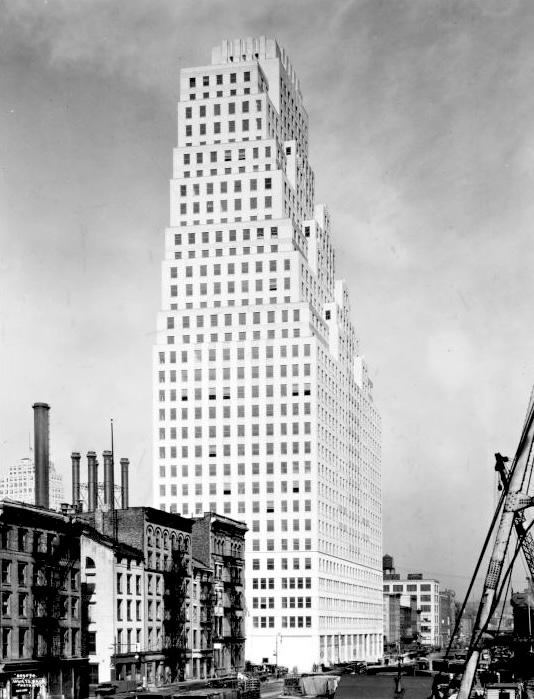

The Wurts Brothers show off 120 Wall Street in the early 1930s:

We’re looking north up South Street, with the East River on the right. (The cables and steel on the far right appear to be a crane on one of the piers.) The building is a narrow rectangle in plan, and we’re looking at the short south side – if you want to count windows you’ll see that the east facade is quite a bit wider.
The architect was Eli Jacques Kahn, who left a series of beautifully-designed little mountains around Manhattan in the 1920s and 30s. In this case, he let the 1916 zoning law dictate the general mass of the building – you were allowed to go straight up from the lot lines to a height determined by the zoning district and the width of the adjacent streets, and then you had to set back at an angle determined by the same two factors. Obviously the law did not dictate the intricate pattern of small setbacks Kahn used.
This building is another example of a developer being clever and leapfrogging away from the heavily-built-up area. There were no comparable modern office buildings on South Street when 120 Wall was built, largely because it was still a working waterfront. The Great Depression and World War II slowed the inevitable filling-in of big buildings from William Street down to the river, with the old warehouses on South Street getting mostly replaced in the 1960s.

You must be logged in to post a comment.