
While walking down the street in downtown Brooklyn:

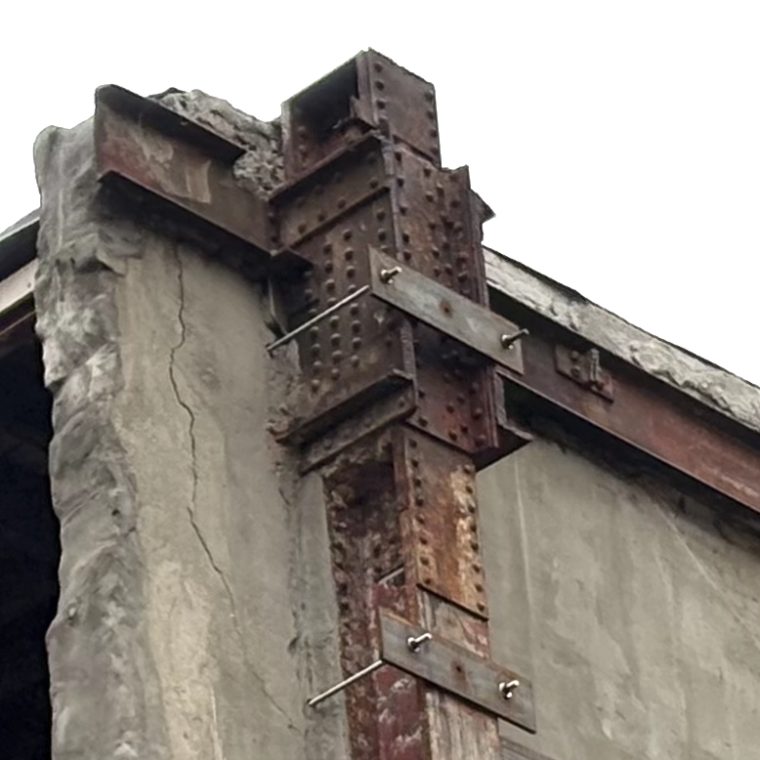
A close-up:

The green construction fence is at the corner of Smith and Fulton Streets. Fulton is up ahead, where the modern building on the right and the ornate white-brick building are; I was standing on Smith. Looking at the 1916 fire map gets me to the addresses, 376 Futon for the partially demolished building with wood joists, and 380-382 Fulton for the empty lot with the green fence:

First mystery: what is going on with that steel? Second mystery: the empty lot is fairly narrow, east-west, but in 1916, it was almost 49 feet wide. It turns out the answer to the second mystery may explain the first. In the 1930, Smith Street was widened in conjunction with the construction of the IND subway. The A, C, and F lines run past this site. So either the building listed on the 1916 map as 380-382 Fulton got chopped in half, more or less, or it was demolished and a new building constructed on the remaining western half of the lot. I lean towards the chopped-in-half theory because the building that was recently demolished was six stories high, the same as the old 380-382, but it could easily have been demo and new construction. Also, there’s a 1935 Certificate of Occupancy saying that it was altered that year.
Assuming for a moment that I’m right about it being an old alteration, how do you deal with half your building getting chopped away? The natural answer for NYC engineers is “put in some steel.” Look closely at the second picture above: the column is a wide-flange section rather than built up and riveted together. That suggests the steel is mid-1920s or later. If I’m wrong and a new building was constructed after the street widening, it still makes sense that we’re seeing 1930s steel. Which means…I’ll never know the answer without a lot of research.
As for why the steel is fastened to the building next door, I assume that’s got something to do with the logistics and sequencing of the buildings being demolished.


You must be logged in to post a comment.