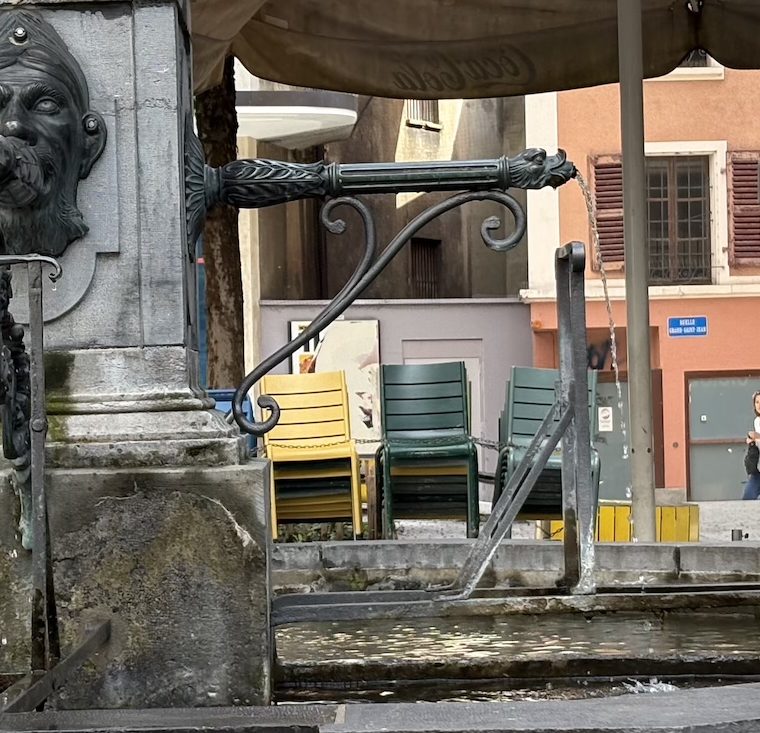

From Lausanne, two slightly different takes on the intersection of physical use and ornament. (For people with very long memories, I might say “utilitas” and “venustas.”) First, a fountain in the plaza I mentioned yesterday:

I know nothing about the history of water supply in Lausanne, but in very general terms going back a couple of thousand years across (at the least) Europe and the Americas, municipal water-supply systems fed water water to public fountains first, and only later to individual buildings. Here’s a close-up at the base of that fountain:

Each face of the central plinth has a pipe to send out water. You can see them clearly on the left and right sides, with the curved brackets used to brace the cantilevered pipes. Note the frames mounted directly below the pipes’ ends: I’m fairly sure those are to allow someone to hook a bucket while it fills up, rather than having to stand there holding it the entire time. The ornate pipes and bracket are necessary, although they could be plainer. The frames are unnecessary but make the fountain more useful for the mundane purpose of providing water for people to take home.
Second, a wide-flange section in the hallway at EFPL:

My guess is that this was a piece of someone’s research, was subjected to axial load in a hydraulic press until it buckled, and was then given a second purpose as a piece of art. But maybe someone made it look like that intentionally as art and it found a home in an engineering building’s hallway.

You must be logged in to post a comment.