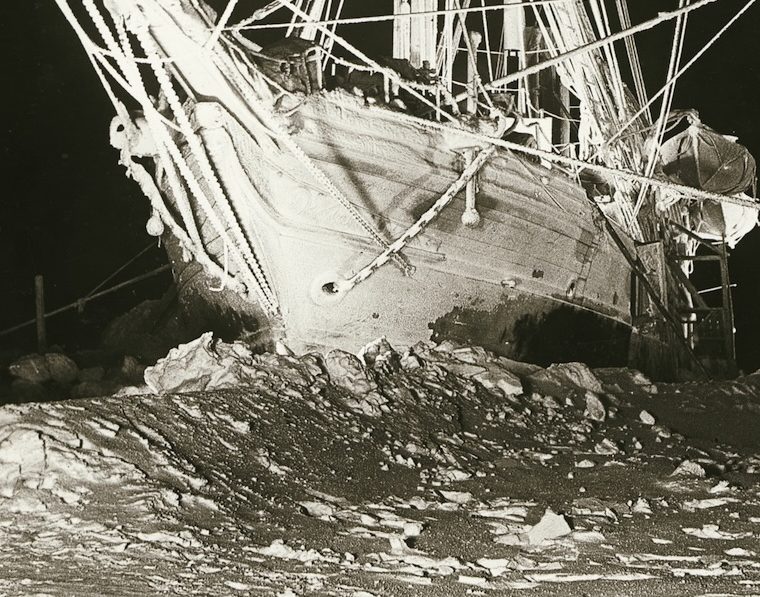

A fascinating discussion of what is, effectively, a structural failure: Here’s the real reason Endurance sank. Polar exploration in the nineteenth century was focussed on first the Arctic Ocean and the Northwest passage, and later the North Pole; by the early twentieth century, the hot1 new topic was Antarctica and the South Pole. Ernest Shackleton was a major part of three separate Antarctic expeditions, and is today most famous for his role in the Imperial Trans-Antarctic Expedition, which failed to live up to its name because Shackleton’s main ship, Endurance, was crushed by sea ice and sank in the (southern hemisphere) spring of late 1915, after about eleven months trapped in the ice. I read Shackleton’s account of the expedition, South, some time ago, and it’s riveting2.

The article on the “real reason” is based on a recent paper by Jukka Tuhkuri, “Why did endurance sink?,” which argues, fairly persuasively, that the structural design of Endurance did not include structural bracing against ice pressure that had allowed other ships to survive similar circumstances. That requires a digression into the structure of ships…
There are two main types of structural action in a ship, counterparts of the local and overall structural actions in a building. The first is the local effect of various pressures, whether the loading on a deck (or floor), loading on the hull (or facade), or something similar. This is quite similar in theory between ships and buildings, although the details are different.
The second is the action of the structure as a whole against its own weight and external loading. This is far worse for ships than it is for most buildings: in an ordinary building, the environmental loading (gravity, wind, and earthquake loads are the most common) is fairly predictable. To give one example of why ship design is more difficult, the ship as a whole may be supported by waves at either end (“sagging”) or in the middle (“hogging”) and so can be a simply supported beam, a double cantilevered beam, or any support condition in between. The hull and decks have to be designed as single large beam – analogous to a building being designed as a cantilever beam for lateral load, but with multiple possible support conditions.
The failure of Endurance was related to the first kind of loading. A ship that is not embedded in ice has reasonably constant inward pressure from water, with some increase from wave impact. Pack ice can greatly increase that pressure as well as create locally-intense pressures. The kind of internal bracing that Mr. Tuhkuri discusses would not have increased the second (overall) strength, but would have increased the first (local) strength of the hull and decks. Interestingly, engine rooms, which were not present in many of the nineteenth-century polar-exploration ships, create a weakness if the engines are big enough to require a double-height space.

You must be logged in to post a comment.