
A circa-1900 bearing-wall building, designed by someone who probably wore a belt and suspenders, and also stapled his pants to his hips:

The stone mullions separating the windows – at both the four-window group and the two-window group above – are structural posts, carrying the load from the stone lintels down to the wall below. Note that the lintels are only one window wide, rather than having a single massive stone running the full width.
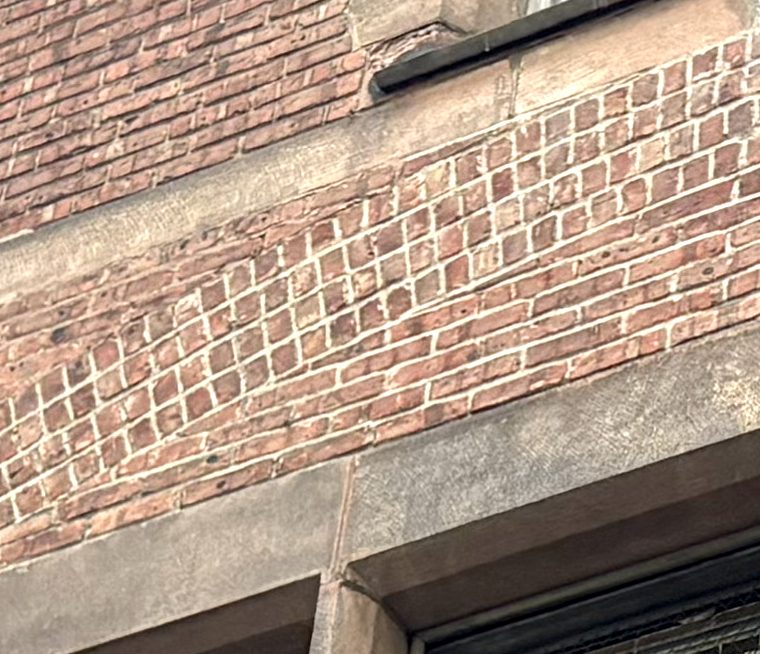
Above the window, in the spandrel panel between the wills above the lintels below, we have a four-course relieving arch built into the brick and spanning the full width of the four windows. First, you rarely see a relieving arch this big in US practice. Second, the arch is loaded pretty strangely: it may have a point load at the center (see below) and then no other load at the crown, and then distributed loads on each end. That’s a place where the depth of the arch comes in handy: it gives some local stiffness to even out the stress. Third, the wall is four wythes (16 inches) thick, and the bricks making up the arch are effectively headers, spanning two wythes, so the arch is actually two identical arches, one in the outer two wythes and one in the inner two wythes.
Since the lintel and mullion set-up is the same at the two windows above that mullion is again load-bearing. There was no obvious relieving arch there, but there might be one hidden in the middle two wythes of the wall. If there is, the upper mullion load is very small, and the point load on the lower relieving arch is small; if there isn’t, the point load at the center of the lower arch is reasonably large, form the wall above the upper windows.
The whole design is probably overkill, but it worked. And it has continued to work despite some decades of poor maintenance. And the masons at the time knew how to build something like this as a matter of course, which meant it wasn’t particularly expensive or time consuming. So…was the overkill wrong?


You must be logged in to post a comment.