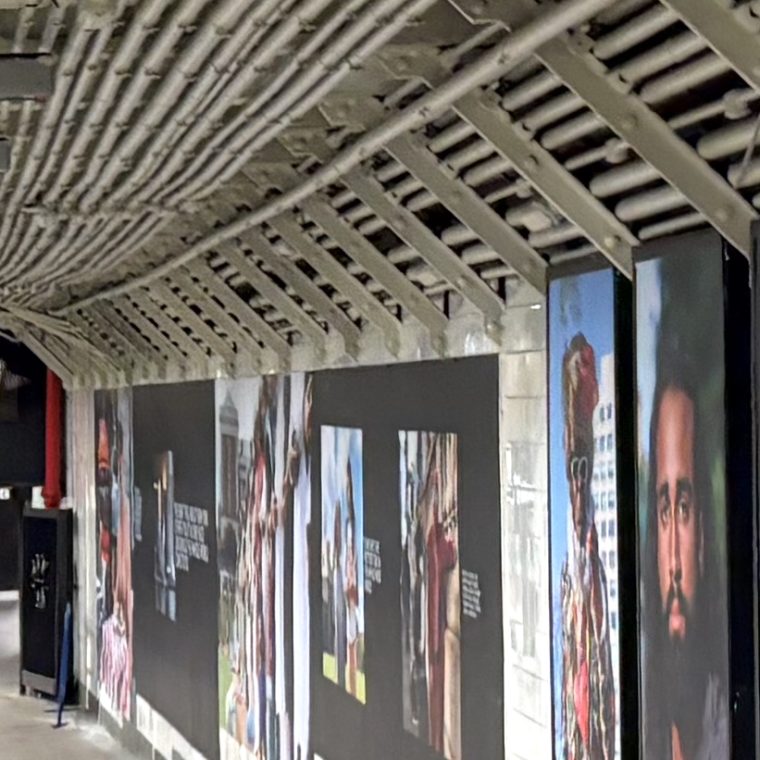

Walking underground from the Madison Avenue entrance to the subway complex next to Grand Central Terminal east to the 4/5 train:

It’s a weird-looking walkway, and a weird connection. I’m repeating myself and repeating some well-known history, but it needs to be said for the follow-up to make sense. The route of the original 1904 IRT subway was a very lazy Z shape, running north from City Hall up the east side (first Lafayette Street, then Fourth/Park Avenue) to Grand Central, then west on 42nd Street to the (newly-renamed) Times Square (at 42nd, Seventh Avenue, and Broadway), and then north up Broadway. Less than a decade later, this was broken up into three lines: the east side portion was extended north up Lexington Avenue (moving east a block to avoid the New York Central tracks under Park north of Grand Central), the west side portion was extended south under Seventh Avenue and Varick Street, and the east-west portion under 42nd Street was isolated as the Shuttle, connecting the two main lines.
The subway station at Grand Central was moved to the diagonal link between the old Park Avenue tracks south of 42nd and the new Lexington Avenue tracks to the north. Here’s the way Apple Maps shows that today:

There are two places with the label “Grand Central-42nd St).” The one on the left is at Madison and 42nd, and you’ll note that the gray line along 42nd, which indicates the shuttle, ends there. (The 7 train, indicated by the purple line, came later and is much deeper underground to avoid intersecting the older subways.) The green line shows the east side IRT curving from Park Avenue to Lexington; the modern station platforms are on the diagonal portion.
So where were things originally?
The 1910 Sanborn map doesn’t show the subway itself, but it shows the curved line of the encroachment of the subway tunnel under the Hotel Belmont at the southwest corner of Park and 42nd:

The hotel was named after its primary owner, August Belmont, who also by a complete coincidence was the controlling owner of the IRT subway. In any case, the curved line that runs from the northwest corner of the building to the middle of the east side, within the word “Belmont,” is labelled as the west wall of the subway tunnel, within the hotel basement.
The 1911 Bromley Map is more useful:

There’s the outline of the tunnel, curving from Park onto 42nd, and the location of the express platforms (serving all four tracks of the subway) running from west of Madison Avenue to Vanderbilt Avenue. So, finally, we’ve found the walkway from my photo: it’s the east end of the old station area, from Madison heading east, and it ends when you get to the big connection area which is under 42nd and the south edge of Grand Central, starting at the corner of Vanderbilt. I always assumed that the passageway was part of the old tunnel itself, but it turns out it’s part of the old station. The modern Shuttle station is in the old tunnel and includes part of the west end of the old station.


You must be logged in to post a comment.