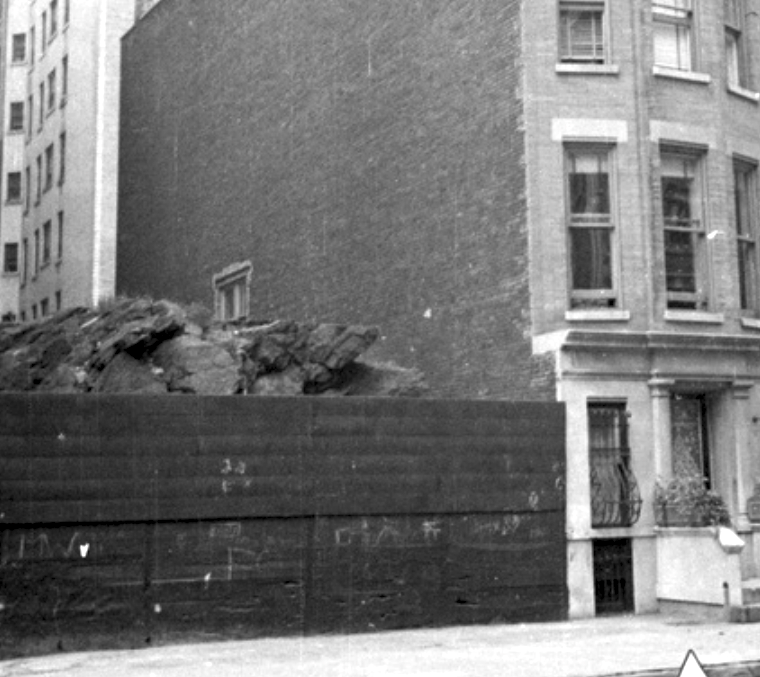

Two people, within two weeks of each other, independently asked me about a giant piece of schist — also known as Rat Rock — down the block from where I live. Both wondered aloud about the oddity of such a massive rock sitting in an undeveloped lot in Morningside Heights, right in the middle of a densely packed neighborhood. When asked why it was still there, my first answer was simple: because it was too expensive to remove. The second time, however, the question came from a documentary filmmaker devoting serious time to the rock. So I decided to do my usual “15-minute research” — the amount of effort I put into context background research — to see if I could back up my claim with some data.

The short answer confirmed my initial hunch, but the process — combining a bit of urban history, building technology, and common sense — is worth describing. It’s a method we often rely on at OSE to better understand buildings and their context.
I already knew that Morningside Heights developed relatively late because it was considered less desirable land. In the second half of the 19th century, the area housed an orphanage and the Bloomingdale Asylum “for the insane.” It also wasn’t easily accessible: the steep cliff at Morningside made travel difficult until the IRT subway was built in 1904. Things began to change in the late 1890s when the Cathedral of St. John the Divine replaced the orphanage, and Columbia University bought the asylum grounds to move its campus uptown. Developers soon followed with speculative housing projects.
Progress was slow at first. For example, in 1895 (based on the not-always-reliable Department of Buildings website — but I’ll take it for my 15-minute research), the building east of Rat Rock, at the corner of Broadway and 114th Street, was constructed. A 1940s tax photo — easily accessible online — shows a typical masonry bearing wall building with wood floor joists, consistent with its 1895 construction date. This simple structure contrasts with the taller, more ornate steel-frame, fireproof apartment buildings that went up along Broadway around 1910. Most likely, that corner building was built inexpensively at a time when developers weren’t sure whether the neighborhood would take off. In that context, it made sense not to bother with removing the massive boulder next door.

Even more telling are the rowhouses west of the rock (visible in the top photo). These were built in a truly penny-pinching manner. According to fire insurance maps, the houses are incredibly narrow — only 14 to 15 feet wide — and were constructed in 1896 (per Andrew Dolkart’s book on Morningside Heights) as speculative development. That means the developer bought standard 25-foot-wide lots and subdivided them to squeeze in as many single-family homes as possible. The façades also have very limited ornamentation for the period, another sign that money was tight.
Could the developer technically have built another building where the rock sits? Yes — but it would have been extremely costly and labor-intensive. Removing that rock in the 1890s, with the corner building already standing, would have required many small loads of dynamite (pneumatic jackhammers weren’t widely available yet). Rowhouses of that era typically had basements — often with additional cellars below — and buyers expected those spaces. Simply shaving off the rock to street level (it rises more than a story above grade) wouldn’t have sufficed, since much of the rock extends below ground. Financially, the far easier choice was to leave the boulder in place and shift the rowhouses over.
Once that decision was made — and even after the neighborhood became desirable — it never made financial sense to remove the rock and develop the small lot. Even today, removing it would require serious jackhammering that would likely affect neighboring buildings with noise and vibration. That’s a lot of hassle for a tiny piece of land. Realistically, it would only make sense if the adjacent rowhouses were also demolished and the lots combined for a larger project. That would be complicated — especially since the rowhouses are part of the Morningside Heights Historic District — but not impossible, as Rat Rock, the rowhouses, and a nearby parking lot on 113th Street are all owned by Columbia.
For now, just as in the 1940s, it remains a slightly better spot to put out trash than directly in front of people’s doors.

You must be logged in to post a comment.