
The coffee shop across the street from the Rhode Island Convention Center, looking up:

This is a modern one-story building, apparently built with the taller commercial building next door. So we’re looking at the underside of the roof, with some of the architectural elements (the track lights, the exit sign, the duct grilles) defining a virtual ceiling plane. There is nothing to suggest that there are any problems with the roof’s structural or waterproofing performance; I’m going to assume that Providence’s winters mean there’s a layer of insulation on top of the metal deck.
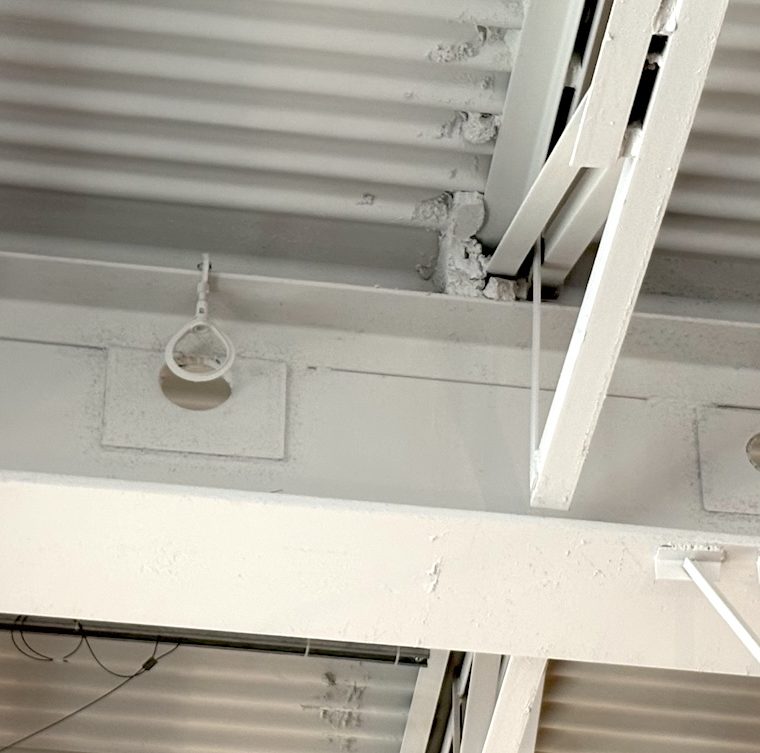
Let’s take a closer look:

The roof structure consists of open-web steel joists supported on steel girders and supporting the roof deck. Those round holes are penetrations cut though the web of the girder for pipe (most likely sprinkler pipe). The little lasso over the left penetration is a pipe hanger. Since we can see a sprinkler pipe running left to right in the first photo, my guess is that the space was renovated after a former tenant’s use.
A few thoughts on the steel design, not in any particular order. First, I really doubt that those small pipe penetrations needed to be reinforced with the square plates you see welded to the web. Shear is rarely a problem in ordinary steel-beam design, and these holes are small compared to the girder depth. My guess here is that analyzing the penetrations to show that reinforcing was not needed would take an engineer’s time and wasn’t included in the budget, while welding on a reinforcing plate was cheaper and faster.
Second, a minor excess: the joists are supported at their top flanges by a shelf angle welded to the girder web, but they have bottom chord extensions at the end. Those extensions are usually added for ceiling supports – and there may well have been a hung ceiling here back when the penetrations had pipes in them – but they look funny this way.
Third, a real design question, again that may be related to the changes over time. There are open-web joist girders that could have been used instead of the regular wide-flange girder. They generally have pretty big gaps in their webs between the various vertical and diagonal truss members, and therefore allow duct and pipe to pass through in the plane of the roof structure without any alterations needed. My guess is that joist girders were more expensive than the wide-flange girder, even with the need to modify the the girder with shelf angles and penetrations, because they are not as off-the-shelf standardized as the plain joists. And the old tenant’s layout may not have had those big ducts.
I’ll stop here, as that’s as far as I got in my analysis before I made it to the counter to place my order.


You must be logged in to post a comment.