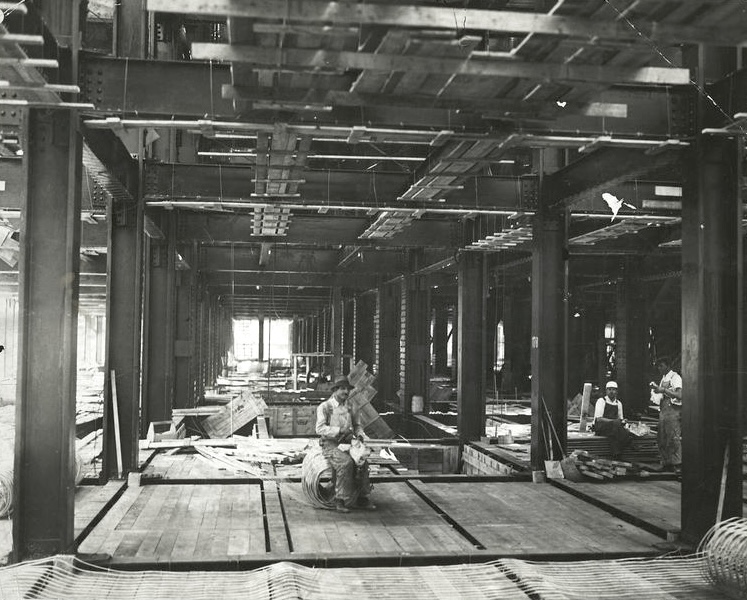

Lewis Hine titled this 1931 photo of the construction of the Empire State Building “Workers having lunch” and it’s hard to argue with the accuracy of that. There is, however, a whole lot more in the frame…

First, given the choice of sitting on a pile of wood plank or sitting on a roll of wire mesh, I’d choose the wood. Maybe I’ve got an unusually delicate sitter.
Second, this photo does a nice job of giving a sense of the utterly repetitive nature of the steel. Piranesian is the adjective, I think.
Third, and most importantly, we’ve got a good view of the floor construction, which is surprisingly hard to find. The floor structure of the Empire State, like that of the vast majority of steel-frame buildings in New York from the 1920s and 30s, consists of draped-mesh slabs. These are thin concrete slabs reinforced with wire that goes over the top of the steel floor beams, which are set up into the slab thickness. The mesh “drapes” down toward the bottom of the slab between the beams, making each wire into a series of catenaries, carrying load in tension in the same manner as the cables of a suspension bridge. These are not reinforced-concrete slabs in the usual sense: the steel reinforcing and the concrete do not work together as a composite material. Rather, the wires carry the load, and the concrete only serves to (a) fireproof the wires and (b) provide an unmoving and opaque floor. The concrete does not have to be particularly strong and as a result most of it is “cinder concrete” that uses coal cinders rather than gravel as coarse aggregate.
In the closest foreground, we see the wire mesh draped over the beams in what will be three panels of floor. in the next bay further away, where the man with a tough sitter is eating, we’ve got the wood formwork between the beams, and visibly lower than the beam top-flanges to allow for the drape. And then in the next bay beyond that, the formwork has not yet been completed. If you look up at the next floor above, there’s no formwork between the beams, but there is wood around each beam. That’s the hung formwork for the concrete that will encase the beams for fireproofing. If you look at the slab formwork on the floor we’re at, you can see the gaps between the edges of the slab forms and the steel beams, which is where concrete will be pushed down into the beam-encasement formwork.
In one sense, there’s nothing new here. The construction details are all well known. But it’s surprising to see it all in one photo: the steel, the beam forms, the slab forms, and the wire mesh waiting for the concrete to come.

You must be logged in to post a comment.