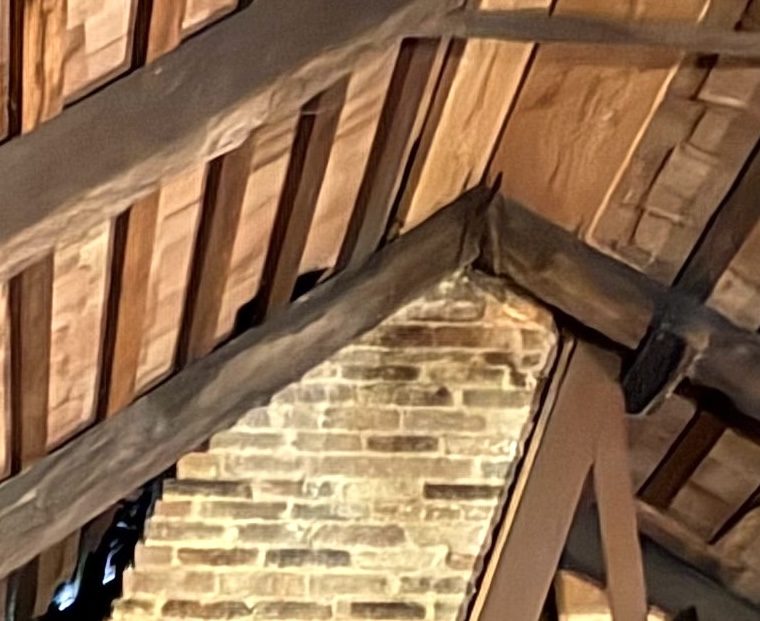

The attic of a very old house:

Yes, that is a chimney on an angle. That’s a fairly common sight in very old houses, as is the wood framing on the underside of the angle, propping (maybe) the masonry. This is what happens when the fireplaces are located where the logic of the interior rooms dictates and those locations are not where you want the chimneys to be.
Why should the chimney be at the roof ridge? Aesthetically, it’s symmetrical and makes the house look more like the crayon drawings of kindergarteners, both of which, I’m sure, are top priorities of designers. The other reason that immediately comes to mind is more practical: keeping the attic dry.
If the chimney ran straight up, it would pass through the roof below the ridge, so one side of the chimney would create a small valley running from the chimney up to the ridge. That would have required fancier metal flashing (which would be more expensive and difficult to build than this wood-shingle roof) and/or a “cricket” consisting of a small secondary slope parallel to the ridge to drain water out of that little valley. By having the chimney at the ridge, there is no such valley…which doesn’t mean that the juncture of the roof and the chimney isn’t prone to leaks, but at least it’s not collecting water and snow.
Some extra work for the mason and some extra framing to support the tilted chimney, or a chimney edge condition that’s more likely to leak. Take your pick.

You must be logged in to post a comment.