
The nature of Manhattan is such that you sometimes can’t see a building you know is nearby and you can sometimes see one from a long distance off if you’re in the right place. Particularly in the regular grid portion of Manhattan, it can be difficult to get an angle to see a building where closer buildings don’t block it…unless you’re on a roof…

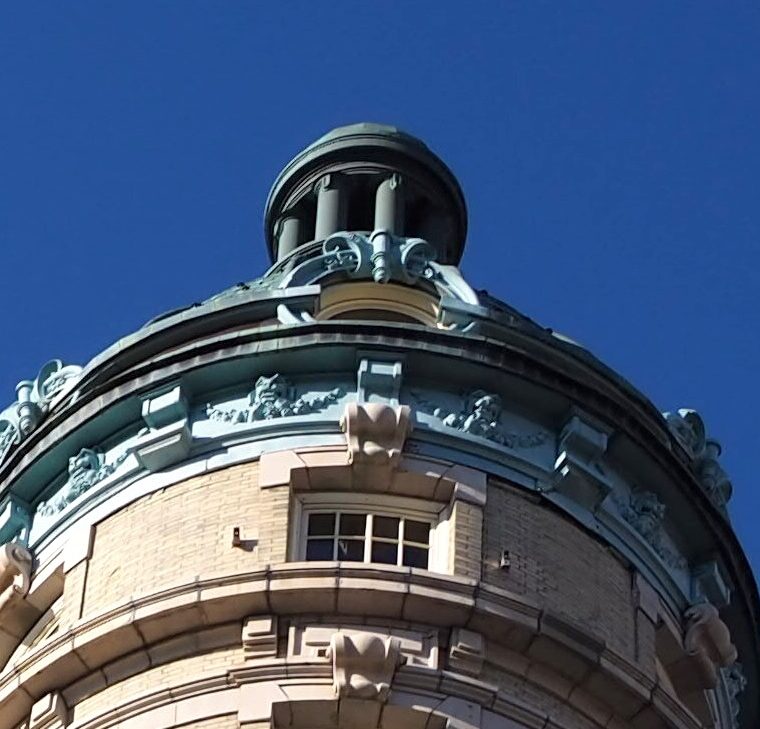
Looking west across Central Park and the lake. See the building with a green mansard and the corner tower? That’s the St. Urban, a pre-war apartment house on Central Park West with a very ornate facade. Last year we completed repairs to that facade as well as two FISP filings (one before and one after the repairs). There was nothing special here in the sense that the building management hadn’t neglected maintenance or ignored problems. Facades gradually deteriorate from being out in the weather. The more ornate the facades are, the more damage caused by water infiltration and freeze-thaw cycles. This building, and nearly all that we work on, has a masonry facade, but metal and glass facades suffer equivalent damage, with only the form of weathering being different.
It should be noted that New York’s climate is particularly bad in terms of weathering: we get a lot of rain (roughly 49 inches per year1) and have a lot of freeze-thaw cycles because in January and February our average daily high temperature is above freezing and the average daily low is below freezing2.
In other words: own a building, spend money on fixing the facade every so often. But the results can look great:


Credit to Tim Michiels, Mel McCloy, and Diane Kaese.
- Compared to an average of 38 inches in Seattle and less than 30 inches in London. Those two famously rainy cities have a lot of overcast and drizzle, we tend more towards alternating sunny days with downpours. ↩︎
- The average lows in December and March are close enough to freezing that all it takes is slightly colder than usual weather and the freeze-thaw cycles extend into those months as well. ↩︎


You must be logged in to post a comment.