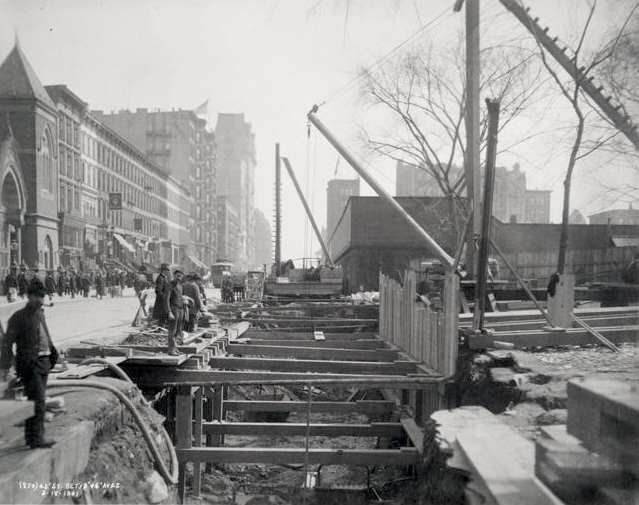

From the NYPL’s “Album of photographs depicting the construction of the Broadway line, New York City Subway”, i.e., the original subway line, comes the 1901 photo “42d Street between 5th & 6th Avenue”:

First, and I know this is exciting, another cut-and-cover subway trench! Something I don’t remember seeing before: the wood masts of the derricks have a bunch of 2x4s (probably) nailed to them to serve as ladders, so that they can be scaled while in use. And, presentism in its purest form, the laborer on the far left foreground smoking a pipe gets to me. To him it was a habit, no different than someone smoking a cigarette today, but it feels different.
Second, this is 42nd Street? It’s one of the most heavily skyscrapered streets in the city today, but then we’ve got a church and a number of brownstones…and a huge glob on the right.
The glob is the easiest thing to identify: it’s the old Croton Distributing Reservoir, shortly before its demolition. That’s the future site of the main branch of the library. Here’s a piece of the index to an 1899 fire map, rather dismissively calling it a “dis-used reservoir”:

As for the other buildings:

There’s the church on the north side of 42nd, just about in line with where the reservoir meets the park, then the row of brownstones at 7 to 25 West 42nd, we’re seeing the 15-story original wing of the Hotel Manhattan (supposedly the birthplace of the eponymous cocktail), and the big blob beyond the hotel, just to the left of the vertical derrick pole, is the second Grand Central, three years old at this point and due to be demolished and replaced in less than a decade.
The original Grand Central, in 1872, was the first thing to differentiate 42nd from other major (i.e., wide) cross streets. The two subway stations that would open in 1904, at Grand Central and at the newly-renamed Times Square were the next. Good transportation made the street a good place for business, which in New York inevitably led to tall buildings, which led to more business. A whole bunch of chickens and eggs, close to simultaneously.
You must be logged in to post a comment.