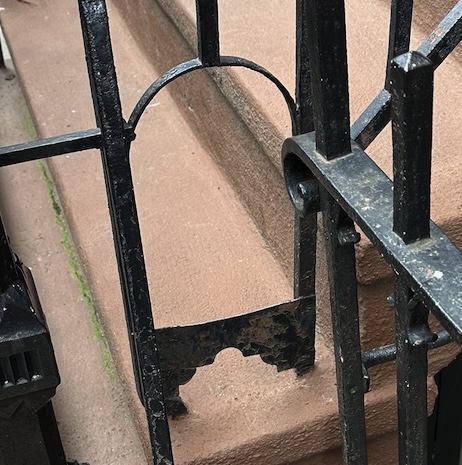

This is the first of what I can guaranty will be an irregularly-published series on the bootscrapers of New York. First up, from Gay Street in Greenwich Village:

This is a fine specimen of the genre, with a cast-iron newel post on the first tread of the stoop, wrought-iron pickets below the handrail, some wrought-iron curlicues where the pickets meet the handrail, a nice iron arch to eliminate the second picket to make room for a foot, and a little decorative shape to the unused lower edge of the scraper itself. The modern refinishing of the brownstone has an unfortunate texture, but seeing as how the stone should never have been used as architectural veneer in our climate, the refinishing is to be expected.
For those unfamiliar with the esoterica of stoops: the bootscraper is the piece of wrought-iron plate at the second step up. (Note that you can see an identical scraper on the other side of the stoop. Not every house had two like this.) As for what was being scraped: “mud” was scraped from the soles of your boots or shoes. This makes it time to discuss the language of the past. There are a number of area in and around New York that had or have the name “meadows.” Lispenard Meadows in lower Manhattan (near today’s Canal Street), and the Hackensack Meadows (better known now as the New Jersey Meadowlands) are two examples. One is a former swamp, the other is a former and current swamp. Similarly, in the New York of the 1800s, the mud in the streets had an appreciable percentage of horse manure in it. Scraping it off before you went indoors wasn’t just about keeping your floors clean, it had distinct odor and health implications. This is why boot scrapers were once so common.
You must be logged in to post a comment.