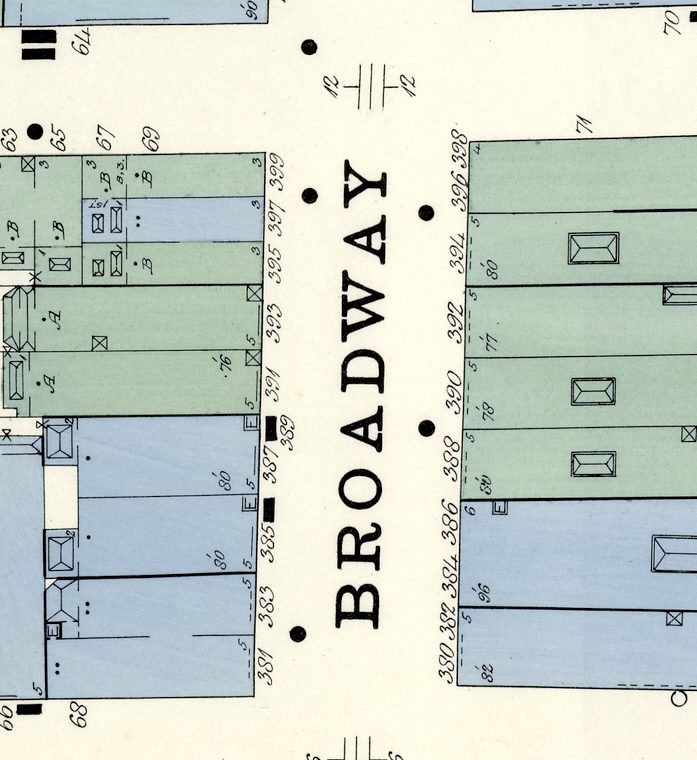

Something I’ve mentioned in passing a few times, but have not discussed in any depth, is the prevalence of nineteenth-century buildings in New York to have their boilers located in sidewalk vaults, which is to say outside the boundaries of the buildings. Sidewalk vaults1 were then, and continue to be now, weird gray areas of responsibility: a vault is connected to the building and so part of it, but it is under the public street and so not part of the lot that the building sits on. In the past they were regulated by the Department of Streets and the Department of Buildings, now by the Department of Transportation and the DoB. Here’s an 1894 view of a piece of what is now called Tribeca, and back then was part of the industrial Lower West Side:
1894
In case that’s not incredibly obvious, the black rectangles are boilers. I’ve circled them in pink:

I count 19 boilers at 17 locations, of which 5 are within buildings and the rest are under the street. There are, of course, many more than 17 buildings in this map, some of which can be explained by a single boiler serving several adjacent buildings owned by the same company, but mostly serving as a reminder that in 1894 steam heat and hot water were luxuries. There was nothing stopping you from heating your building with iron stoves or even open fireplaces.
Here’s another map2 a few blocks away with an even more interesting distribution:

Somewhat fancier buildings along the Broadway corridor, so a larger percentage with boilers. But what really jumps out at me is the way that the boilers are clustered under the tiny alleys of Franklin Place and Cortlandt Alley. As the general layout of the map should make obvious, few3 of these buildings had service courts or other ways to put deliveries of coal out of sight, but if your building had street facades on Broadway and one of the other streets, you could at least get the filth of coal delivery and ash removal away from the side with the main entrance.
The reason for the boilers being in vaults is hinted at by one building, off Cortlandt between White and Walker, with a red circle around its pink circle. The building has a tiny wing, a little extension just for the boiler, as if holding it at arm’s length. Boilers and coal storage were dangerous. Boilers could explode if improperly used or maintained, and did. And coal dust is explosive in unventilated spaces…like coal storage. Every building in these two maps had wood-joist floors4, so the threat of fire was very real. Putting the boilers in a sidewalk vault gained a little room in the cellar, but more importantly, it reduced the fire risk that the boiler posed to the remainder of the building.
- An extension of a building’s cellar that extends past the lot line under the public sidewalk and sometimes under the main portion of the street. ↩︎
- Turned upside down so that north is at the top, as with the first map. ↩︎
- Verging on none. ↩︎
- None are shown in the beige that the Sanborn Map company used for fireproof construction. ↩︎

You must be logged in to post a comment.