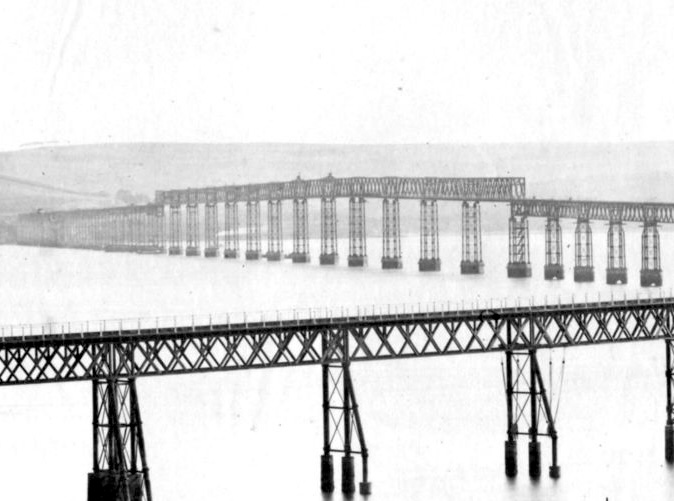

There’s a kind of book I think of as “novelists’ history.” Accurate about facts as far as the sources allow, but written as if it were fiction: great characters, interesting story. John Prebble’s telling of the story of the first rail bridge at the Firth of Tay, The High Girders, is a good example.

The book is not an engineering study, or even a history of engineering. It is, mostly, a description of the way people saw the bridge before, during, and after its constructon, and after its catastrophic collapse roughly 18 months after it opened. Given that Prebble was very much concerned with the history and culture of Scotland, and he presents much of the dialog in a Scots accent, it can read, at times, like a soap opera.
The short version: the bridge was a long viaduct, more than 80 spans, with wrought-iron trusses supported on lattice piers consists of (at the main spans) six cast-iron columns joined by wrought-iron bracing. Most of the spans were deck trusses, with the single railroad track carried by beams connecting the truss top chords; the thirteen longer and higher spans at the center, designed to allow ship passage, were through trusses.
The through-truss center, “the High Girders,” collapsed in a windstorm on the evening of December 28, 1879, while a train was passing. That is probably not a coincidence: the presence of the train significantly increased the wind load, increased the gravity load, and caused a great deal of vibration.

Various forms of damning evidence came out at the inquiry. Trains had probably been crossing the bridge at a greater speed than allowed, the cast-iron foundry had sent columns to the site with severe defects (blow-holes, poor joins, cracks) disguised with non-structural filler, and maintenance workers had reported finding loose bolts and rust in the piers. The worst thing that came out was in one sense not a surprise: there was no explicit wind design for the bridge. The reason I find that not surprising, speaking as a structural engineer in 2026, is that in the 1870s wind design of structures was in its infancy. Designers did not have accurate information about wind pressure based on location, or on how to convert a wind pressure to forces on a structure. On the other hand, the Firth of Tay is famous for bad weather. The storm that night probably had hurricane-force winds.
In the end, both the design and construction were flawed. Cast iron cannot be riveted, and ordinary bolted connections have some play, some looseness. The wrought-iron cross-bracing obviously worked, given that bridge performed acceptably for a year and a half, but the combination of lateral load and vibration would inevitably lead to unanticipated bending stresses in the cast iron. And since wind pressure goes by the square of the wind speed, the stresses created by a 75 mph wind are more than twice those from a 50 mph wind. Modern wind design is based on exceptional events, not the kind of ordinary high winds that you might expect in only 18 months of loading.
Prebble first wrote the book in 1956, when there were still people alive who remembered the collapse. The copy I have is a 1976 reprint. But really, in 1871, when construction started, the idea of the bridge structure was already old-fashioned. The 1879 failure was the result of the use of a form of construction technology that had been largely abandoned in bridges decades earlier. Prebble relays the reactions of ordinary people and railroad workers; the reactions of engineers would have added to the forensic account, if not the social commentary that is his focus.
You must be logged in to post a comment.