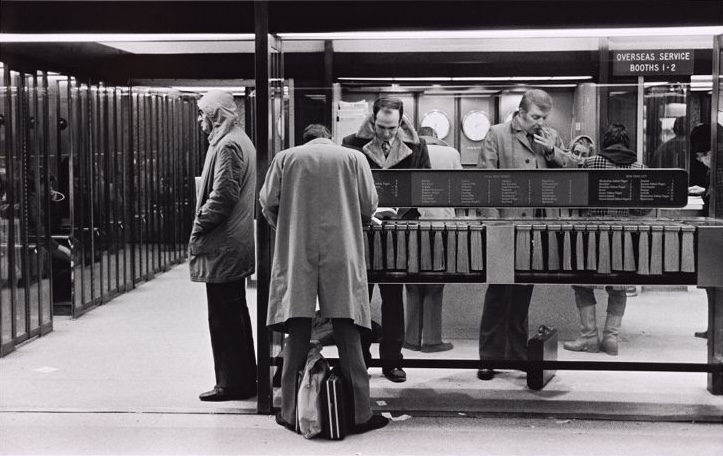

Time to sound like an old, old man. From Duncan Hartley, in 1977 or 78, “Grand Central Telephone Communications Center”:

I assume that at least some of the younger people reading this have never seen anything like that, so I’m going to explain it all. The glass on the far left is a series of pay-phone booths, mostly for commuters waiting for trains. The fellow with his hood up is waiting for a booth to come free so he can go make a call. The table is there to hold all of those phone books, spines up: each book was mounted on a pivot so you could swing it up and then open it without it being disconnected from the table. (That stopped people from stealing the books. It did not stop people from ripping out the page with the number they were interested in.) There are 13 books on the right side facing us, and I’d guess that meant there were 52 at the table. The city was ten books (yellow pages for business categories and white pages alphabetically, for each borough) and the others would have been for the suburbs and a handfull of big cities – Boston or Philly.
This was two or three years before the AT&T monopoly was broken up, so long distance calls were expensive and overseas calls outrageously so. But there were two booths reserved for overseas calls, presumably by dialing an operator. Also, note the row of clocks in the background, in case you were making a distance or overseas call and didn’t know the time on the other end.
My first observation is a facile one: every single thing here was ended by changes in phone technology ending with smart phones: the need for a “telephone communications center,” the difference in cost between local and long-distance calls, human operators for ordinary calls, the need for phone books, the need to wait for a specific time and location to make a call.
The purpose and use of this room would have been broadly recognizable to people from the 1880s onward even as clothing and architectural fashions changed. The change in technology that replaced it, roughly between 1995 and 2010 or 2015, would have been almost as foreign to the people in the photo as it would have been to their predecessors 90 years earlier. It’s easy to forget how fast this all changed, particularly if you never saw the old regime.

You must be logged in to post a comment.