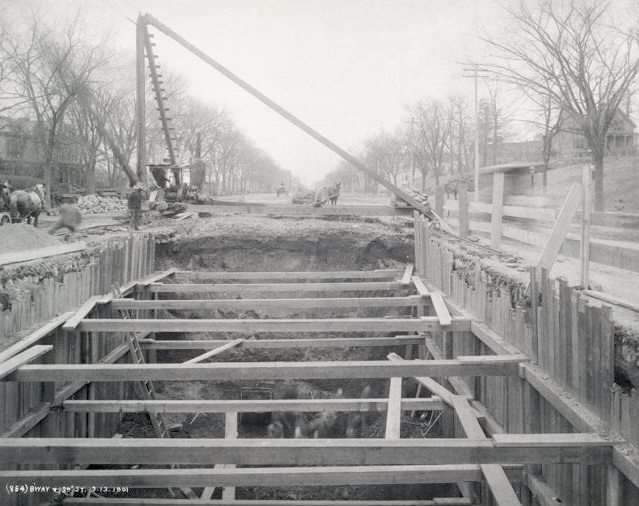

I’m almost done with the photos of the construction of the original IRT subway. This barely suburban scene is Broadway and 139th Street in 1901. The wood used in stabilizing the edges of the excavation – what we call “support of excavation” today – and the horses, and the wood-frame buildings, make this view look older than it is. Head south 116 blocks and the Fuller Company was busy constructing the Flatiron Building.

As always, a few notes. First, the use of wood plank as excavation sheeting continues to this day, although the walers are now usually steel rather than timber. The street is surprisingly clear of buried utilities – I suspect at that time only water and sewers were there, with electric and telephone on the poles we see. The thing on the left, past the derrick frame, that looks like a huge wine bottle is a steam engine, presumably to power an excavator not obviously in sight or maybe the derrick. The safety rail on the right is, to be polite, rudimentary.
Most importantly, and I probably should have been explicit about this when discussing the previous photo, we’re looking at a feedback loop. Upper Manhattan was so sparse then because the reasonably-fast existing mass transit was the Ninth Avenue elevated about half a mile to the east with a very large hill in between. The el crossed over into the Bronx after the 155th Street station, leaving the rest of upper Manhattan dependent on street cars. In short, it took a long time to get to the built-up part of Manhattan from here before the subway opened in 1904. The subway created development in this area, and the development encouraged the construction of more subway lines.


You must be logged in to post a comment.