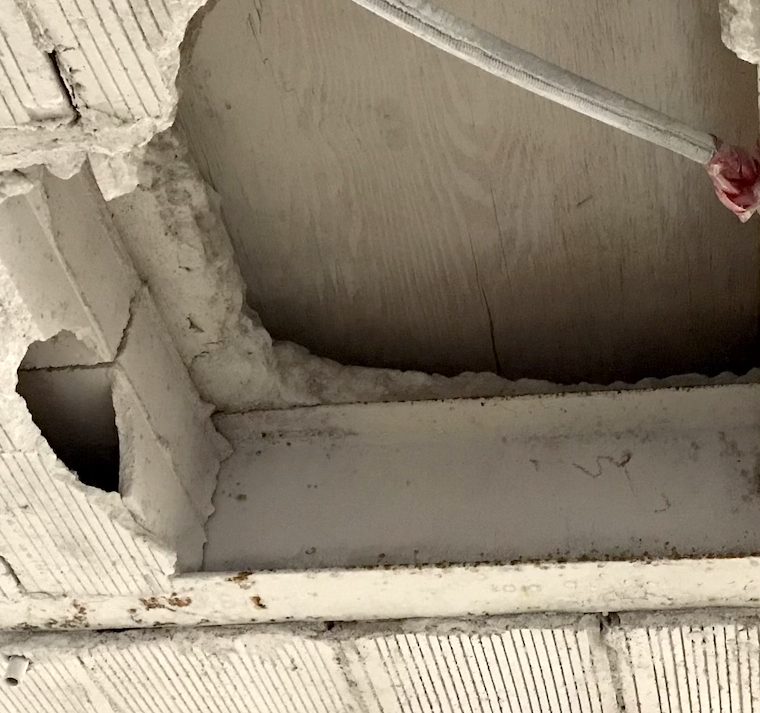

A photo of a tile arch floor from a 2018 site visit:

Starting with the easy stuff: the hung ceiling was demolished shortly before we got there. The terra-cotta blocks are corrugated to act as lath for directly-applied plaster, but in this case the ceiling was on metal lath suspended below the vaults, so there are no little bits of plaster stuck in the corrugations. The flat vaults are spanning up and down the page: we can see one of the supporting steel beams at the big hole, as well as tie rods which, by necessity, run in the same direction as the span. In case you were wondering how thick the terra cotta is around the void space within, the broken block to the left of the big hole gives a pretty good view.
Now for the interesting question: how has the terra cotta spanning to the big hole survived? To be clear, the interior demolition did not create the big hole: it had been there for some time to allow for an air duct to get from one floor to the other, if I’m remembering correctly. We always tell people that mortar is not glue, and that’s generally true, even though mortar does have some tensile capacity. Tile arch floors are masonry vaults: they carry load in compression between their supports, and compression cannot be transmitted through air. So the portion of vault to the left of the hole is working as intended, as is the portion to the right, even with the small holes in both of those areas. But the terra cotta at the top of the picture, to the left of the tie rod, is spanning to nothing. And there is no mechanical interlock between the blocks side to side. So why hasn’t that area fallen down?
A few answers, which are not mutually exclusive: all may be true or any combination of them. First, it is entirely possible that some of the terra cotta has fallen down. The edge closest to us, at the top of the photo, is suspiciously ragged. Some pieces may have fallen here. Second, there is an unreinforced concrete topping slab above the terra cotta, visible on the left side of the hole, that is likely engaged with the top-surface corrugations of the terra-cotta blocks. That slab does not have much moment or shear capacity, but it has more than zero, and it may be helping to spread load from the theoretically-unsupported blocks to the full spans to the left and right. Third, as previously stated, the tensile capacity of mortar, and therefore its ability to allow cantilever action among the discrete blocks, is not zero.
Finally, because this needs to be said: the hole was addressed, not left like this.
You must be logged in to post a comment.