
Once:
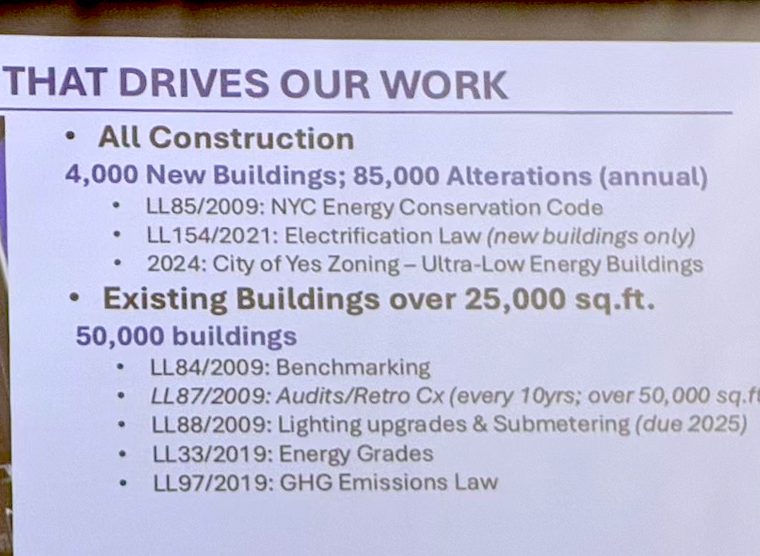
I took the picture below during the first panel of the “Progress and Preservation: Reuse for a Resilient City” event yesterday, put on by the Municipal Art Society. The speaker at that moment was Emily Hoffman, the Director of Building Energy & Emissions Performance at the New York City Department of Buildings. Ms. Hoffman had a lot of interesting things to say, but I was moved to photograph that slide by the text in blue below the first bullet point. In the context of New York having (depending on how you count) somewhere between 1,000,000 and 1,100,000 buildings, the DoB deals with, annually, about 4,000 new building applications and 85,000 alteration applications.

In other words, the field that OSE is completely immersed in – existing-building investigation, repair, and alteration – is the vast majority of projects here. What we do isn’t some fringe niche (Calling all linguists: can a niche be a fringe?) but rather the usual form of building work. To put it really obnoxiously, to one significant figure, existing-building work is what happens in this city, with new buildings being the fringe niche.
Be right back, I’m going to go buy a big foam-rubber hand with the index finger extended.
Twice:
I used the phrase “depending on how you count” above and it applies here as well. There are things listed as “posts” in the WordPress dashboard for our website that are not blog posts. Some of the oldest web pages, for example, show up in the posts grouping. That said, depending on how you count, some time in the last two weeks we passed 4,000 blog posts, and the current streak of posting at least once every day is at 540 consecutive days.
Putting aside the issue of whether I have too much free time – I don’t – and whether my free time might be better spent – I doubt it – the basic goal of writing for the blog has not changed. This blog exists to talk about anything involving the built environment, particularly in NYC, that anyone in the office finds interesting. The hope is that if we find it interesting, other people will as well. It turns out that there’s a lot to say on the topic, particularly when you write it in 300-word chunks.


You must be logged in to post a comment.