
A number of trees grow in Brooklyn…

There’s an interesting interview with Sarah Wigglesworth, an English architect, here. In the space of two or so pages, she touches on a number of important topics, including equality in the workplace and university, green building, and neighborhood sustainability. That last item is the one that caught my eye, because I believe it might be the answer to a question that came up in discussion about two years ago.
That discussion, which I was happy to be part of, was a bunch of architects and engineers who work in preservation trying to figure out if preservation and green building were allied, antagonistic, or indifferent to one another. Being professionally optimistic* most of us started from the position that of course preservation and green building went hand in hand, but the longer we talked the less clear that conclusion was. Green building generally includes measuring metrics that don’t exist or are hard to find for pre-modern construction. It is focussed** on the energy and materials used in construction and the waste produced by construction. What about the energy and materials saved by not demolishing and building new? What about the efficiencies of some forms of old construction?
The idea of sustaining a neighborhood, as mentioned by Ms. Wigglesworth, got me thinking that the proper connection between green and old is in the goals. Why do we care about green building? To preserve the natural environment. Why do we care about preservation? To preserve the built environment. The first obviously benefits all living things, not just people, but if we are anthropocentric for a moment, the goals more or less coincide. You can’t make the overall environment better for people if you’re degrading water and air; you can’t make it better if you’re degrading the appearance and utility of the places where people spend their lives.
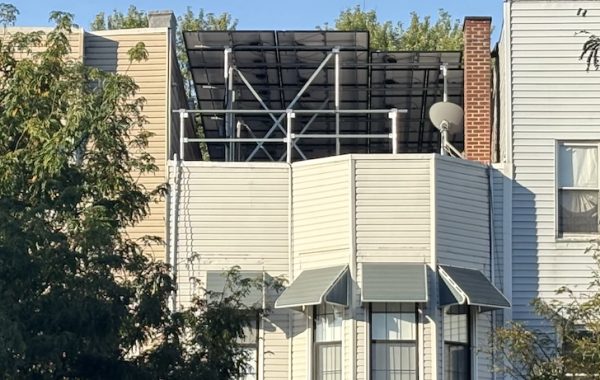
As I’ve mentioned a number of times, we think that saving existing buildings has cultural value because the buildings are part of people’s lives. Beyond that, saving old building inevitably means saving various aspects of past living. Our office, built in 1930, has operable windows. The brownstone neighborhoods of Brooklyn have the same walk-up, low-rise scale that cities have had as long as there have been cities. Old buildings often have smaller floor-plates in order to take advantage of natural light. All of these aspects relate to the goals Ms. Wigglesworth states in the interview and all can in part, be achieved simply by keeping old buildings in use.
* Working in preservation is an inherently optimistic act. We believe our work will matter indefinitely into the future.
** LEED as originally defined was almost exclusively aimed at new buildings. The more recent versions have partially corrected this oversight.

You must be logged in to post a comment.