

Here’s a link to a digital publication on the New York Crystal Palace, with a bunch of worthwhile essays on that very peculiar building. Full disclosure: I’ve spent more time thinking about the Crystal Palace than is healthy, leading to a paper, with Brian Bowen, comparing it to the earlier London Crystal Palace* and another paper, with Gabriel Pardo Redondo, trying to analyze its metal frame using modern standards.
As fascinating as the New York Crystal Palace is, studying it as a building – as opposed to studying it as an exhibition or a time capsule of mid-1800s New York – is a dead end. There’s an obvious link that can be made between this early iron-framed building and New York’s role in the development of steel skeleton framing, but unfortunately that obvious link is wrong. Historically, there is no link. There was no sudden growth in metal framing in New York after the construction of the Palace, no sudden change in the direction or speed of metal-frame technological growth, no change in the businesses supplying and erecting iron. The extensive use of cast and wrought iron without masonry was effectively a one-off, forgotten when it was complete.
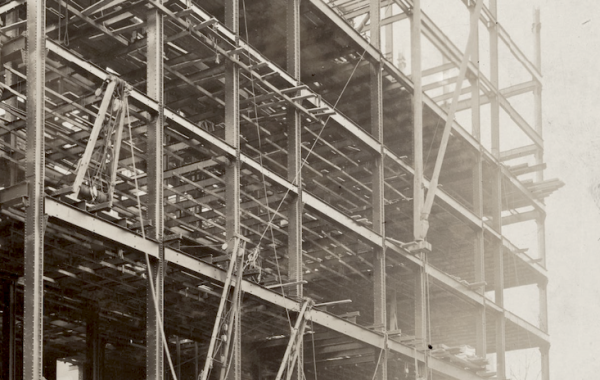
I am suspicious of any claim that a specific instance of technology is “the first” or “the only” because these are so rarely true. Technologies of any kind develop as interconnected webs** of smaller technologies in many instances. To stick with building frame development, the first skeleton-frame buildings*** were the result of decades of gradual changes in iron and steel use, terra-cotta floors, and masonry walls. There was no abrupt revolution, just an accumulation of small changes.
An easy test to see whether an object represents the main stream of technological development is to see if it was copied. For example, once the idea of supporting the exterior masonry walls of a building on its interior metal frame had been demonstrated, it was copied again and again, with refinements and improvements repeatedly introduced. Nothing about the Crystal Palace was copied for decades after, because no one saw the point of doing so. Imitation may be flattery, but replication is proof of a good idea.
* Spoiler: the London building is structurally more interesting and far larger.
** That’s actually what the whole idea of the “industrial revolution” is about: the interconnected development of cast iron, coal mining, and steam engines in the UK in the late 1700s.
*** The London & Lancashire Building in New York, and the Manhattan Building in Chicago, both constructed in 1890.

You must be logged in to post a comment.