


That’s an overall view and a closeup view of a larger-than-usual tree pit facing Cooper Square. The curb between the pit and the roadbed of the street has two low points in it – see the close-up for a view of one of them – that greatly resemble curb cuts at a crosswalk. They’re not curb cuts, because there aren’t pedestrian paths at those two locations. Rather, it appears that the low points are intended to allow rain runoff to enter the pit and collect there rather than following the ordinary path along the gutter to a sewer grate. That would fit well with the large pit size: this is a form of cistern or dry well intended to hold runoff, and it incidentally has a couple of trees in it.
One such pit doesn’t do much, but if this design were to be more widely used it might make a dent in the amount of rainwater that the sewers have to handle. Since we have combined sewers in NYC, that have to carry both rainwater and sewage, excessive runoff can lead to our sewage-treatment plants being overwhelmed, which in turn leads to sewage being released into the rivers before it’s fully treated. These pits are not the only experiment that’s being tried.
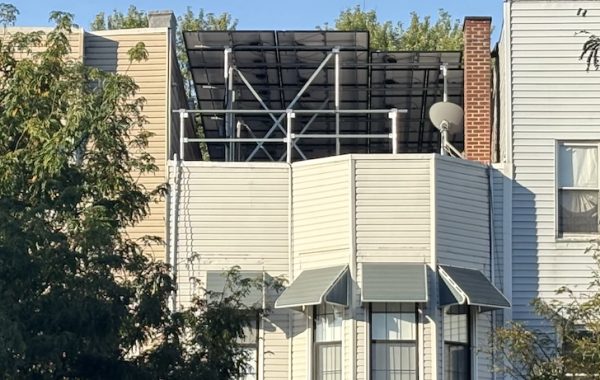
What’s most interesting is that this experiment reverses the century and a half of centralization of the sewer system. In that, it’s similar to the way that rooftop solar panels reverse the long trend towards centralization of electric power. There’s a huge difference in scale between the centralized, grand-plan system and this local alternate, and it’s important to acknowledge that the local alternate could not be used at a scale that would eliminate the need for the centralized system. But the two can work together, with the local alternate reducing some of the demand for the central system, and thus helping it to work better.
You must be logged in to post a comment.