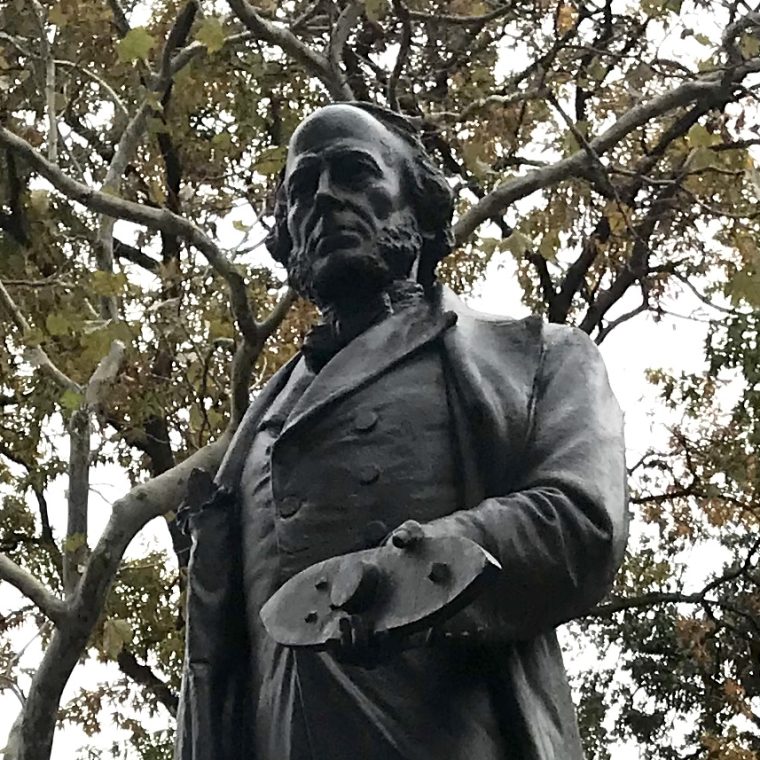


Some years ago, I stayed in a hotel in central Glasgow, near George Square. I was pleasantly surprised to find an impressive statue of James Watt in the square. It occurred to me then that the reason I was surprised was that engineers are so rarely represented in statues in New York and in the US in general. Off the top of my head, I couldn’t think of any (see below) although I knew that John, Washington, and Emily Roebling have plaques on the Brooklyn Bridge.
It turns I out I had missed two sculptures, one because it’s a little obscure and the other because I can apparently walk past something hundreds of times without noticing it. First there’s a monument and bust dedicated to Alexander Lyman Holley in Washington Square. It was sculpted by JQA Ward, who was one of the most prominent sculptors in New York in the late nineteenth and early twentieth century, so this is serious stuff. Holley was a mechanical engineer, best remembered today for his work on improving the production of Bessemer steel, so his work distantly touches on mine.
The picture above is the other sculpture, which is at the fringe of Battery Park, near Bridge and State Streets. It’s a monument to John Ericsson, another mechanical engineer, best known today for designing the USS Monitor. It’s not bad, although less heroic than Watt’s seated pose in Scotland.
If we look at the statues in Central Park, which are in some sense the most public in the city, the best represented group is writers. Architects don’t fare much better than engineers, as the only sculptures I can think of are designers in their own buildings: the grotesque of Cass Gilbert in the lobby of the Woolworth Building and the busts of John Carrère and Thomas Hastings in the lobby of the New York Public Library.
We need to work on this. It’s quite easy to come up with a list of civil and structural engineers who have done as much to shape New York as anyone: the three Roeblings, Gustave Lindenthal, Othmar Ammann, Ole Singstad, Gunvald Aus, William Starrett, and William Barclay Parsons would be my first pass. It’s also worth noting that five of those nine people were immigrants, which is not so different from the composition of our local engineering community today.


You must be logged in to post a comment.