

That’s 135 Hudson Street, an 1887 warehouse most noted when it was new for its plainness and therefore its place in the new architecture of the late 1800s. It’s now, like pretty much everything else in Tribeca, very expensive apartments. The architect was Francis Kimball, who a few years later would be designing several impressive early skyscrapers. Let’s take a closer look at the first floor arcade:
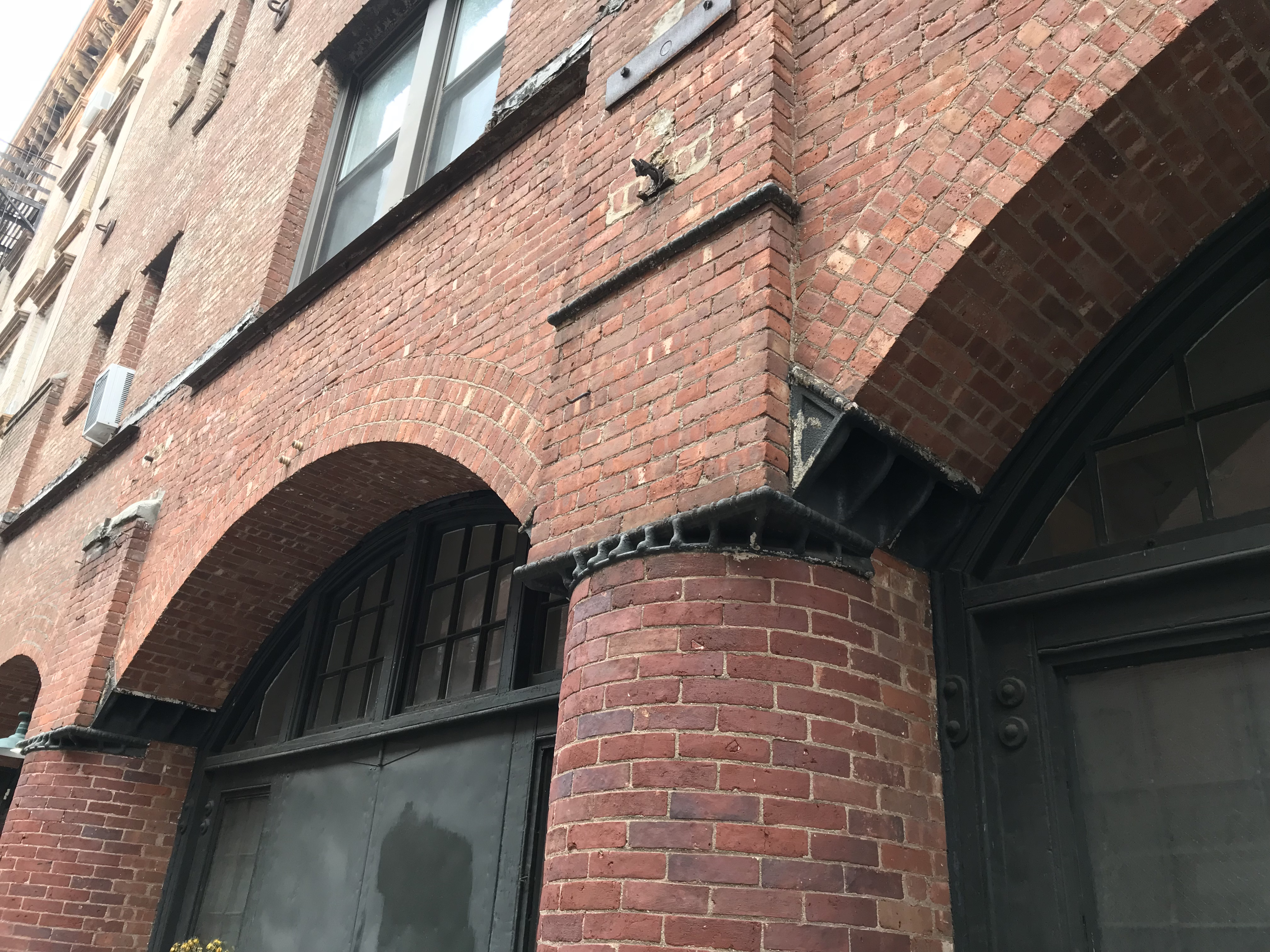
Above the arcade, the walls are walls, solid planes with cut-outs for windows. Below the arcade, the walls are individual round piers with a lot of open space between. The arches are four courses of brick high: taller than normal facade arches in NYC, and for the good reason that they are carrying a lot of load. This is not a cheap building, as can be seen at the piers, which are formed with bricks molded to the curve rather than common, rectangular-prism bricks.
The detail that grabbed my attention is the transition from the arches and the rectangular pier built into the upper wall to the round pier below. If you look closely (click to expand) you can see two plates (one on top of the circular pier, one below the square pier) and two triangular ears that serve as abutments for the arches. The ears spring off the upper plate; the two plates are connected by a series of vertical plates with curved edges. That whole thing is one big iron casting. That shouldn’t come as a surprise, as New York was long a center of iron casting, but the 1882 building code, which barred the use of iron without fire-protection, was the beginning of the end for the material, as cast-iron facades were no longer allowed. I’m not actually sure how this design got past the Department of Buildings, although the logic may have been that the iron was not really structure but only secondary.
This detail is nearly perfect, given the constraints of the era and the building. The transition between two differently-shaped piers and two arches is handled simply, with no fancy masonry geometry. It’s been working for 131 years, so I think it’s safe to say that it is empirically adequate. It is beautiful in its own way. But more than anything else, it has all the qualities that the modern movement in architecture was looking for: it’s economical, it’s structurally expressive, it’s as minimal as was feasible. I find it to be more impressive than the full iron facades of the preceding decades.

You must be logged in to post a comment.