

That’s Buckhill Lodge, a private house located within Kensington Gardens in London. As I approached it and took this picture, I was surprised and thinking that carpenter’s gothic wasn’t really an English style. Then when I got closer, I realized that I had made a category error by making an assumption. Here’s the trim on the gable on the left:
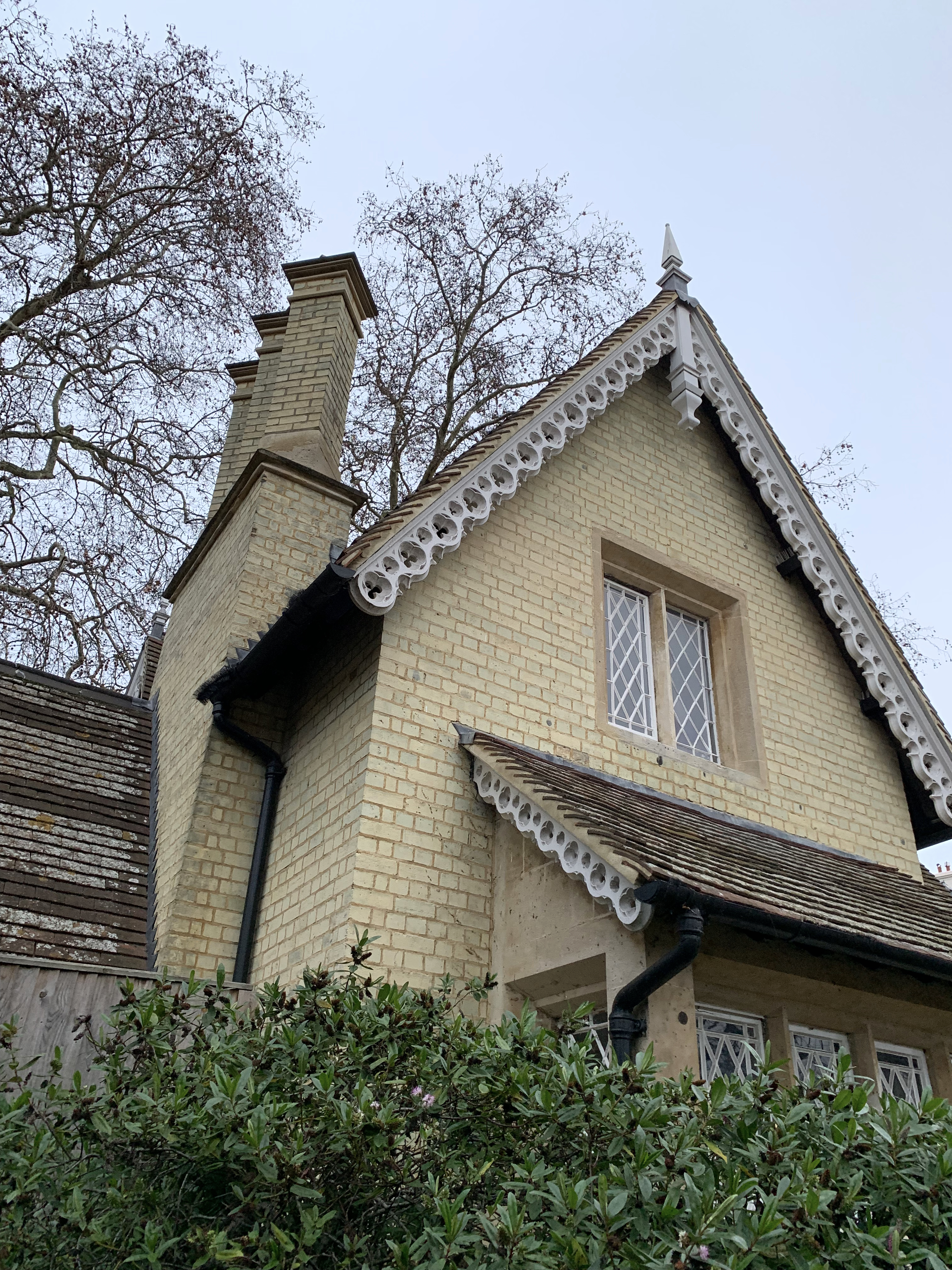
If you look closely (click on the picture to expand it) you can see that the cut-outs in the trim are three-dimensional. In other words, the ornament is composed of parts of spheres, cones, and other less-regular 3D shapes. The similar-looking trim on a carpenter’s gothic house is basically 2D, consisting of boards that have openings of amazing complexity cut into them but with the same dimensions all the way through the thickness of the board. No matter how ornate that ornament gets, it’s geometrically simpler than the trim on Buckhill Lodge.
Why? Why is carpenter’s gothic such an American style? The answer is house-building technology. The wood-working tools used in colonial America were similar to those used in western Europe although often cruder and not the most current variations. House design in America quickly differentiated from that in Europe because of the incredible abundance of wood and particularly soft pine. There was no need to use masonry anywhere but the chimneys and foundations, because wood was so cheap and readily available. The next big change was the development of “stick” construction in the first half of the nineteenth century, where entire buildings were constructed of 2xs and 3xs. The heavy tools for carving mortise and tenons and other large-timber connections, already in declining use in the US, really fell out of favor. What was left? Among other things, scroll-saws, also known as coping saws or fret saws. They were good for cutting curves and sharp angles quickly, and lent themselves to ornament based on cutting patterns into thin boards. In London, where stick construction was not being used, the chisels and other tools necessary for 3D ornament were still a major part of wood construction.
Note that I am not suggesting technological determinism on a small scale. In fact, the reverse seems to be true: people in the US wanted the Victorian/gothic style and got it in a slightly different form that people in England, based on the way that wood was worked in the different countries. The visual result – the social value referred to in determinism – is nearly the same even though the technology is different.


You must be logged in to post a comment.