
The phrase “they don’t build them like they used to” is always good for some laughs. There are certainly differences between past and current practice, but there is no consistency in terms of quality. Some things in the past are better than their current-day counterparts (the quality of ornamental brickwork, for example) and some are worse (the solidity of foundations, for example). The cliché assumes that the past was always better, which is simply not true.
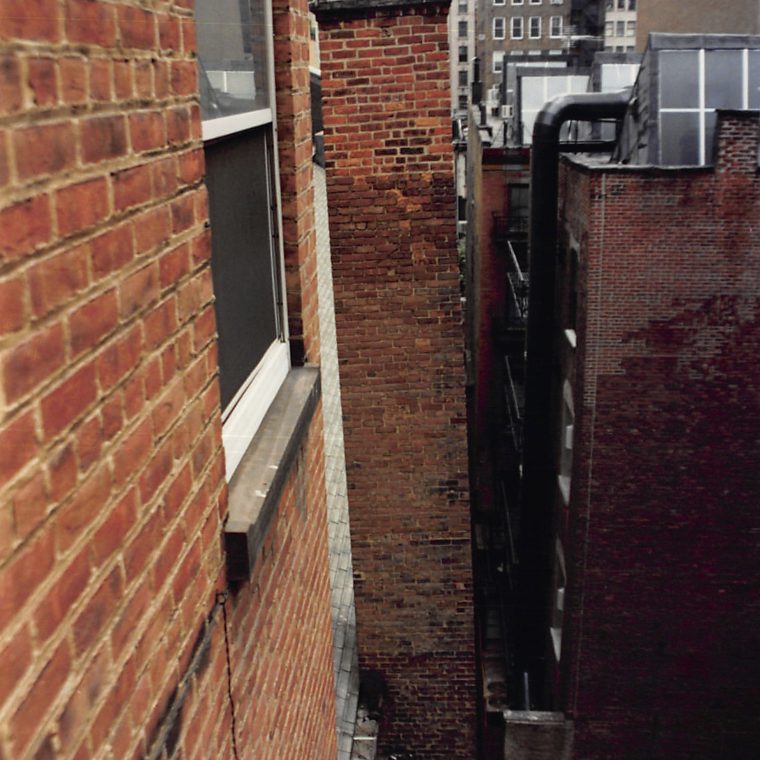
The picture above is some twenty years old, and I mention that because the problem it shows was fixed a long time ago. It shows a side yard from a window of the building on the far left. The tall rectangular brick thing in front of us, more or less centered on the photo, is a mid-1800s chimney carrying the boiler flue for a church. You can just make out the sloped roof of the church to the left of chimney, in the narrow gap between it and the building I was standing in. An important fact is that the chimney was built some 20 or 30 years after the church.
If you look at the gap between the chimney and the building, the problem is clear: the chimney is sloped to the left. If you look at the intersection of the sloped roof and the chimney, towards the bottom of the photo, a possible reason is clear: the chimney encloses the edge of the sloped roof. The gutter you can see came much later, but there’s a corralled brick projection at the top of the wall that supports the roof eave, and that brick interrupts the near side of the chimney. Not entirely, but enough so that side (of the four that make up the chimney) is weaker. It’s also the side that gets water, snow, and ice shed onto it from the roof. Here’s a picture looking up that shows the dramatic difference between the chimney below the eave (vertical) and above the eave (not):

How did this happen? There are two obvious possibilities. The first is that people building the chimney constructed the foundation tight to the church’s foundation wall without looking up to see that there was a projecting brick corbel at the eave. The second is that they knowingly built the chimney so that the eave cut into its side. The chimney masonry isn’t tied to the adjacent wall, so the chimney is effectively free-standing, so there’s no reason (other than the fact it would have been funny-looking) that there couldn’t have been a small gap.
I’m trying very hard to not say that those builders some 170 years ago screwed up, but I think I’m failing. They constructed a time bomb that eventually went off.

You must be logged in to post a comment.