
Tracey Lindeman’s article “A Modernist Gas Station With a New Purpose” got me thinking about adaptive reuse, which is not surprising since it’s about an adaptive reuse project. That project, where Éric Gauthier took a Mies van Der Rohe gas station in Montreal and turned it into a community center while keeping the basic appearance of the structure, is certainly deserving of the article and praise. But if we look past the famous original architect, how rare is such reuse?
Because of the kind of projects we work on, I’m probably biased, but it seems to me that cities are full of adaptive reuse. Apartments in former manufacturing lofts, hotels in former apartment houses (and vice versa), offices and retail in former rowhouses, apartments in former offices (and vice versa), schools in former factories, and so on. The only type of conversion that I can’t think of is from residential or office to industrial use, because the heavier floor loads would require a lot of reconstruction. But even then there’s at least one example: Thomas Edison’s Pearl Street Station, the first commercial electric generating plant in the US, was built out of two small and very old commercial buildings.
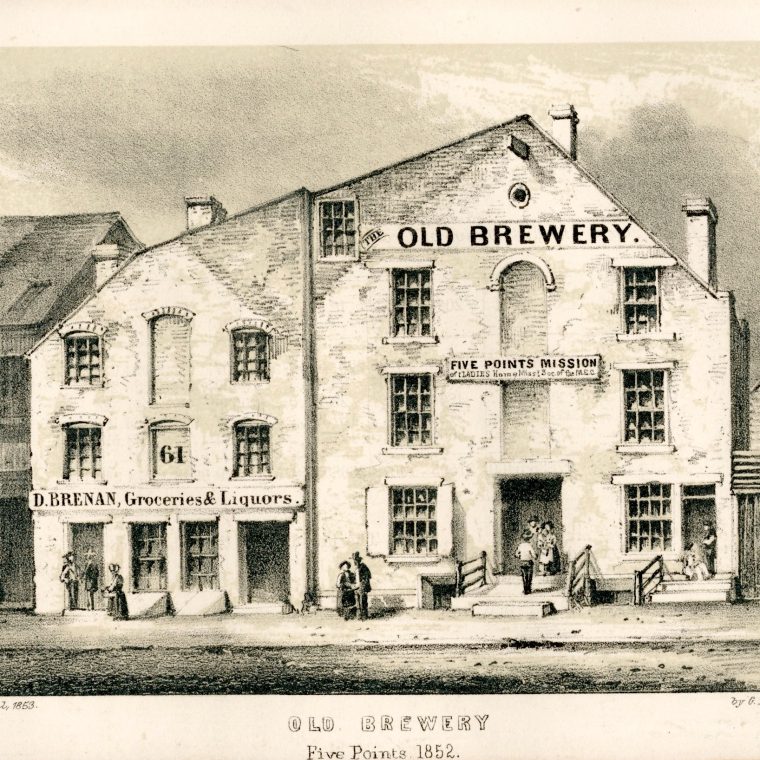
The picture above is a different type of conversion. The Old Brewery was constructed in 1792 on the shore of the Collect Pond. When the pond was filled in, the new street layout had the brewery at the center of Five Points. After the brewery went out of business, it became a tenement and flophouse.
So what separates La Station in Montreal and the Old Brewery in New York from all those other thousands of changes in use? They’re interesting stories largely because of issues unrelated to adaptive reuse. If the gas station hadn’t have been designed by Mies, or if the Brewery hadn’t been held up as the epitome of bad housing by reformers for decades, would we know about them? Buildings change use all the time and because they’re not otherwise famous, their change in use is not famous. And, from the preservation viewpoint, that’s probably for the best. A lot old buildings stay in use because they’re reused and no one really notices.