
The criteria for determining whether or not a building is historic are a mixture of completely objective and completely subjective. If a structure has to be 50 years old to be considered for a specific category of preservation, then there is no debate to be had: it is that old or it is not. On the other hand, if it has to have a distinctive architectural style, we can all debate endlessly on what that means. The notable old buildings in a given city or a given area usually can be grouped into a small number of categories, like “wood-framed houses of the early 1800s,” or “single-lot commercial buildings of the 1920s.”
In the interest of openness, I’m going to state here what I believe to be my biases: I like the buildings of the post-Columbian Exposition “American Renaissance” period (more or less 1893-1915) and I like the corporate version of Art Deco that was popular in the late 1920s and 1930s. Despite working on a lot of 1880s and 1890s rowhouses, I’m not really a fan of the various Victorian house styles. My taste doesn’t matter much since I am rarely involved with the decisions about which buildings are to be saved and what architectural elements or features are important.
Nicole Javorsky’s essay in CityLab, “This Architecture Historian Wants You to Respect Queens” struck a nerve. She discusses the Queens buildings of the 1950s and 60s that are studied by historian Frampton Tolbert. Her piece is worth reading. It takes a look at buildings that are background noise to many people but represent the history of Queens and architecture in a particular era. Some buildings of that type were landmarks of my childhood, such as the mid-century modern Ebenezer Baptist Church (1969) in Flushing, which I walked by on a regular basis.
Queens had a population of about 1,800,000 when I was born and over 2,200,000 now, so despite its secondary status in the popular image of New York, it’s big enough that generalizations are going to have a lot of exceptions. That said, the borough’s physical environment has suffered a messy and incoherent street layout, being ignored by developers and (to a lesser degree) the city government as a place to put good design, and being ignored by preservationists as a place to look for good design. Hopefully Mr. Tolbert’s efforts and Ms. Javorsky’s essay can help.
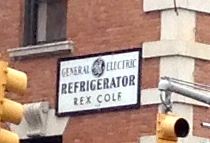
Finally, I want to mention one small building that has been modified in such a way that its historic appearance is gone. Raymond Hood had a series of showroom commissions from Rex Cole, an appliance manufacturer, in the 1920s. One of them was on Northern Boulevard in Flushing, and it was a good example of what Robert Venturi and Denise Scott Brown later termed a “duck,” a building that serves as its own sign. The building had roughly the proportions and exterior surface (using glazed white brick) of a Rex Cole refrigerator, including a roof decoration that resembled the vent that the appliances had on top. It was more or less intact in the 1970s, when it held a Weight Watchers, but has since lost its top and been reclad. Hood was a big name in architecture at that time, as one of the foremost creators of the corporate deco skyscrapers I love: he rose to fame with the Tribune building in Chicago, but then designed the American Standard, Daily News, and McGraw-Hill building in New York and at Rockefeller Center led the team for the RCA building. The fact that Queens had a small gem by him to lose is a good summation of the preservation situation there.