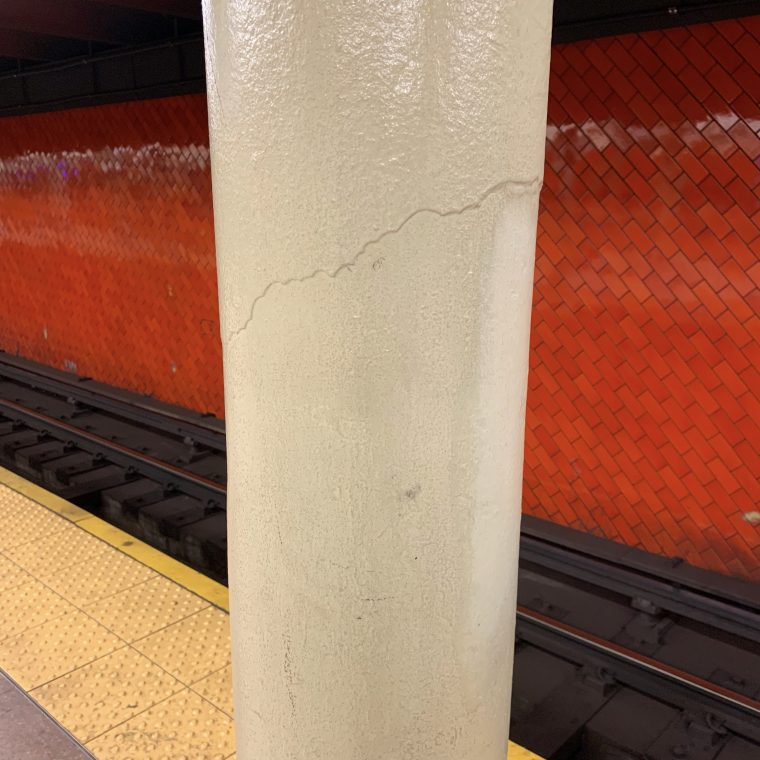

The good news is that column isn’t broken. What appears to be a jagged break line running diagonally across is actually the border between where the old paint was removed prior to the last painting (bottom) and where all of the various coats of paint going back to 1905 are still present (top). It’s not that amazing that 114 years of paint has a noticeable build-up. It’s also not that amazing that all of that paint wasn’t properly stripped.
That column is in the Bowling Green Station on the Lexington Avenue line (the 4 and 5) and it’s holding up the street above. The load on the column is mostly dead load: the concrete roof, the earth fill above, and the concrete and asphalt of the street above that. Sure, there are cars, buses, and trucks loading the street, but they weigh little compared to the concrete and earth. The fact that the column load is basically static is good news, since that’s a cast-iron column. The subway structures built between 1900 and 1940 (the main trunk lines of the underground portion of the system, and some of the elevated lines in the outer boroughs) are generally steel-framed with concrete slabs and walls, but the very earliest parts of the system have cast-iron columns in the stations. It’s not clear why – the tunnels built at the same time have built-up steel columns – unless it was that the designers of the Interborough Rapid Transit system thought the round cast-iron columns were more decorative.