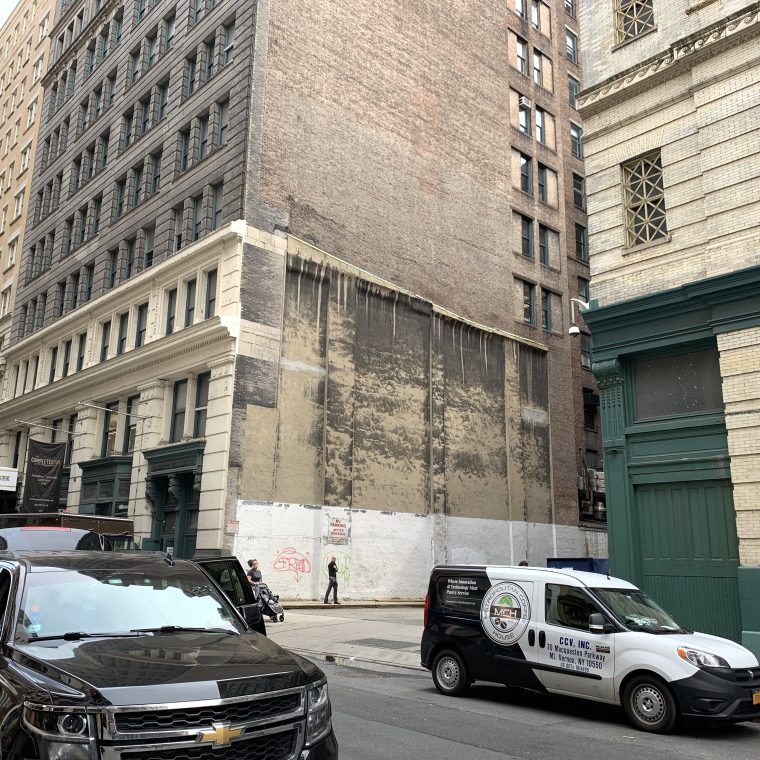

This missing building is pretty much in line with my previous examples, but there are some interesting details. First, given the width of the lot, I’d guess that there were two small buildings demolished to create that vacant lot. It’s a busy block and always has been: that’s the old Siegel-Cooper Store on the right (yellow brick and green trim), and three big loft buildings center and left. The missing buildings might have been rowhouses or might have been small commercial buildings like the one on the far left (above the FedEx truck). That distinction is pretty vague, since a lot of these small commercial buildings started off as rowhouses and were converted by getting a front extension to move their facades up the sidewalk lot line and removing the stoops and areaways.
The idea that the missing building that left that impression in the side of the left was a rowhouse is given some weight by the shape of the impression, which seems to have a chimney up front, although the two narrower vertical lines of brick are a bit hard to explain. More importantly is that everything we’re seeing is in the negative, created by the absence of portions of the outermost wythe of brick in the loft building’s wall. That suggests that a rowhouse party wall was present when the loft was. built and later demolished; a suggestion that only makes sense if the builders of the loft did the right thing and provided a full-thickness wall where they were next door to the older building. Another bit of evidence for that theory is that no joist pockets are visible, suggesting that the old side wall is completely gone.
As a side note, the two vertical lines of windows over the rear of the missing building have been made considerably smaller. They were originally large windows like we usually see in manufacturing lofts, but have been reduced to fairly ordinary double-hung windows by having more than half of the size of the original wall openings infilled with brick.
My favorite detail concerns the string courses above the second and third floor on the loft. They sort of wrap around the corner, in a flat manner. The missing building obviously ended a few feet short of the sidewalk lot line, and the loft’s designers, rather than have these decorative elements disappear at the corner, kept a visible reminder of them. The cost was small, as the side-wall portion of the string courses was just flat masonry, but it’s the kind of attention to visual detail that people often mean when they say we don’t build like we used to.