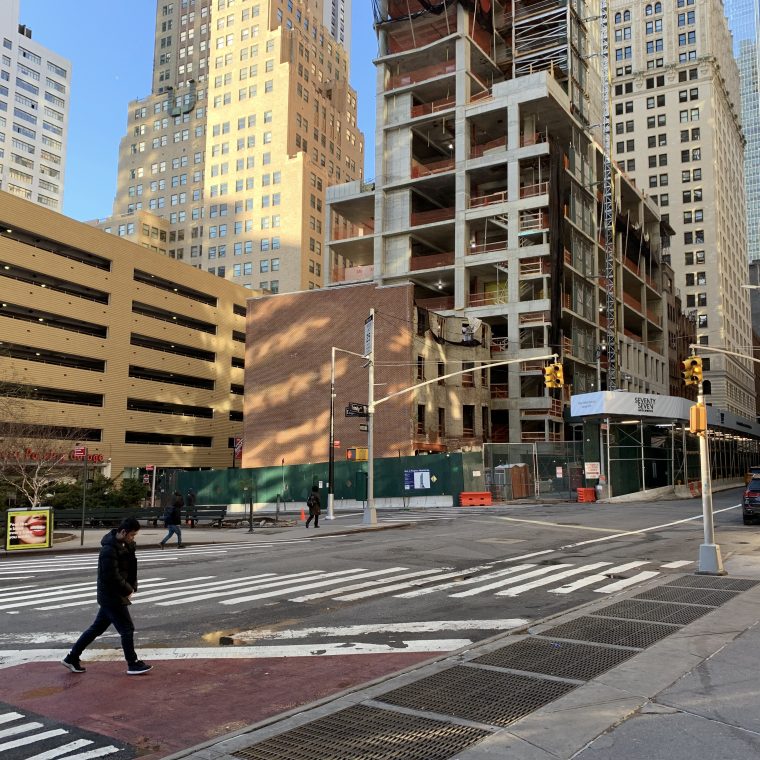

I’ve written about the stabilization of the Dickey House before, but the picture above shows something else: the house in its current context. The building with the horizontal slot window openings (if you look closely, no actual windows) is the back of the south wing of the Battery Garage, built in 1950. The taller buildings left to right were constructed in the 2010s, the 2000s, 1920s, 1900s, 2010s, and 1900s. The tower that is part of the same project as the Dickey House is obviously still under construction in the center.
In one way, this is a nice summary of lower Manhattan: a 200-year-old house is surrounded by high-rises from a more-than-hundred-year span. In other words, more than half of the house’s history has included skyscraper neighbors. In other, other words, Manhattan has the world’s largest collection of old skyscrapers, and a lot of them are within a five-minute walk of the house.
From a more purely preservationist point of view, this is less nice. Buildings as cultural artifacts have physical contexts as well as historical ones. That is why so many preservation debates concern buildings adjacent to historic sites. The Dickey House was built for a well-to-do family and was surrounded by houses for their well-to-do neighbors; the buildings were later converted to boarding houses. That residential context is completely gone. It’s no one’s fault unless you want to blame the development, since 1800, of lower Manhattan as a commercial district, but it matters. Regardless of the current project, there is no way to look at this house and see what it once was, any more than you can look at the Ford River Rouge plant and see the natural bottomland it was before the factory complex was built.
I’m not saying that the house should be (or should have been) demolished. I’m saying that there are limitations to preserving individual buildings, and that landmarking is therefore an imperfect method of maintaining the past. Imperfect, but also the best method we have.