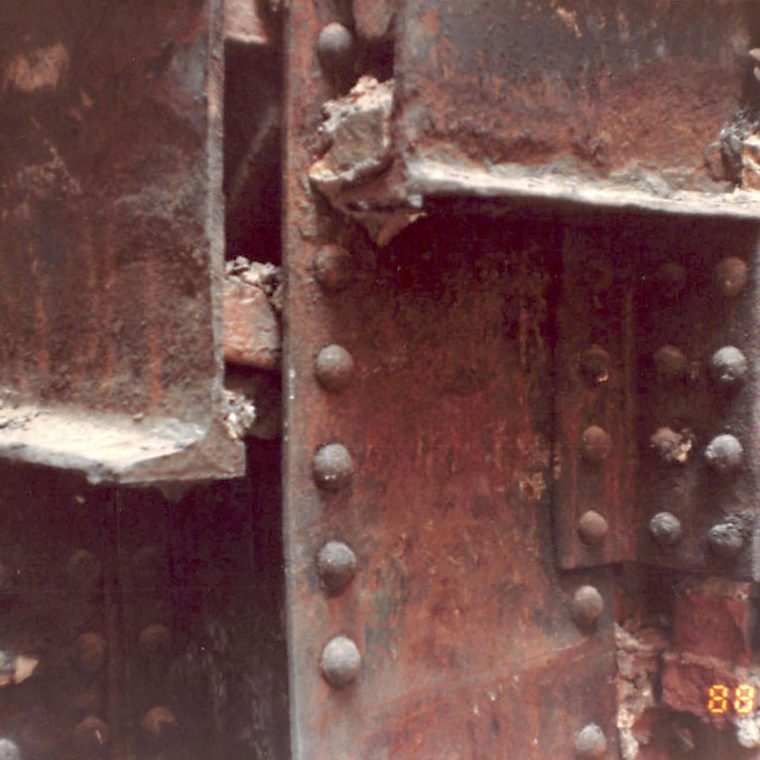

I didn’t intend to write a follow-up to yesterday’s post about expansion joints, but I find that old buildings lead me do a lot of things that I don’t start out intending to do. The obvious question raised by yesterday’s brief discussion of expansion joints is why it took so long for them to be recognized as important. Skeleton-framed buildings with masonry curtain walls go back to 1890, so why did it take about 80 years for codes and practice to catch up with the need for expansion joints?
There is no single answer that fits. “Architects and engineers are dumb” is a possible answer, but one that requires that everyone else – building owners, contractors, maintenance workers, and so on – to be equally as dumb, which seems unlikely. (In the list below, I’m going to refer to “people are stupid” as “answer zero.”) Here are a few other possible answers, of varying degrees of plausibility:
- The earliest masonry curtain walls are barely distinguishable by physical characteristics from the bearing walls they replaced. Since expansion joints are not used with bearing walls, no one realized they were needed with curtain walls. This relies partly on answer zero to make sense.
- Related to answer 1, curtain walls got thinner so slowly – from four and sometimes more wythes of brick in the 1890s to three wythes in the 1900s, to two wythes in the 1920s – that people didn’t notice the qualitative changes in performance that accompanied the gradual changes in geometry. This relies partly on answer zero to make sense.
- Structural aspects of curtain walls were for a long time neglected because they were too structural for architects and too architectural for engineers.
- Most of the time, it takes decades for the damage to show up, and the designers are long gone from the building by then. This relies on a specific form of answer zero: that people involved with design and maintenance are too dumb to talk to each other.
- The rapid rise to popularity after WWII of glass and metal curtain walls (where expansion joints were built in) obscured problems with masonry curtain walls. People’s attention was elsewhere, which is a form of answer zero.
- Starting in the 1970s, the regular inspection of high-rise facades created a new body of knowledge about patterns of damage. This answer violates causality, as the inspection requirements were enacted after the expansion joint requirements.
- It’s difficult to tell cracks resulting from unexpected structural load from other forms of curtain wall distress. See answer 6 regarding inspection.
- The gradual switch from solid curtain walls to cavity walls meant that more and more facades have as veneer a single wythe of brick or thin veneer panels. While these veneers are mechanically fastened to back-up (masonry or studs) to prevent gross movement, there is much less capacity for load transfer between the veneer and the back-up and so any incidental structural load would cause more severe damage.
All of these may be true to some degree, or any combination of them. Personally, I lean towards answer 8, with a light sprinkling of all of the others. But the most interesting hidden issue here is that all of these answers are historically contingent: if architectural trends had been different (less movement towards glass, for example) the need for expansion joints might have been noticed sooner.

