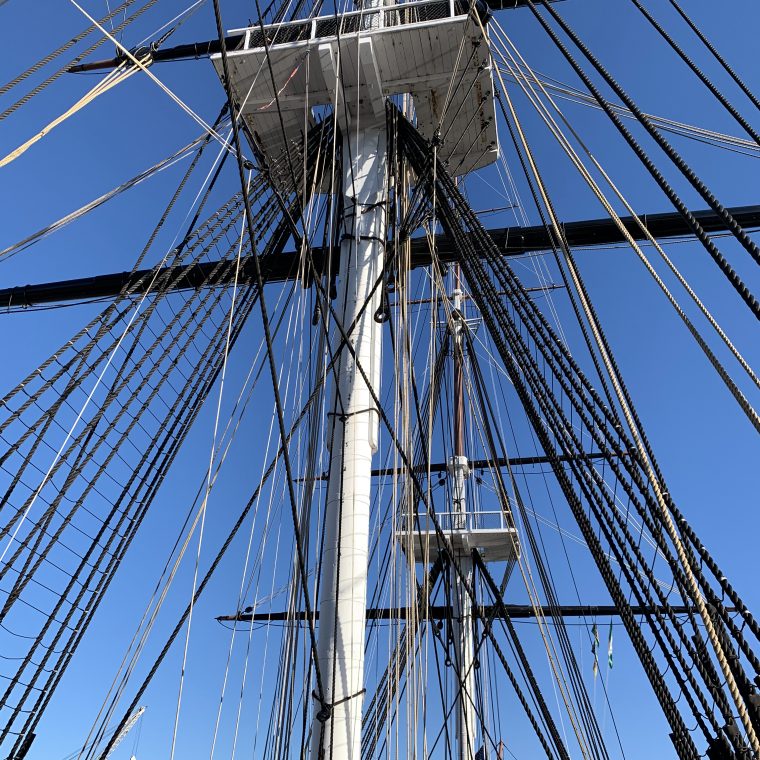

I took that picture on the deck of the USS Constitution, which turned 222 years old yesterday. It’s only a small portion of the rigging, but it’s enough to give a sense of the complexity of it. As someone who knows a bit about carpentry, I expected to be bowled over by the framing of the ship’s hull and decks – and I was – but the sight of the rigging got me thinking about definitions in technology. Specifically, I’ve been thinking about the definition of “a machine.”
Like a lot of other concepts important in our work, “machine” is a little fuzzy. Most of the definitions you’ll find imply that a power source is an integral part, that having multiple pieces is integral, that having a function is integral. I can think of exceptions to all three of those criteria, so they are guidelines at best. And of course, the “simple machines,” the definitions that are hundreds of years old but form the basis of a lot of technology, are single-piece and unpowered.
If you had asked me a week ago if the Constitution‘s rigging was a machine I’d have said no. Now, I’m pretty sure it is. Every rope, every piece of wood, every sail has a specific purpose when acting in combination. The power to make the machine function comes from the wind and from human muscles, but so what? Wind turbines are powered by the wind and few people would deny that they’re machines. More important than the power source is the design: the complexity of the pieces is the result of specific decisions made, in the usual engineering manner, to trade off weight against strength, flexibility against reliability, simplicity against function, and so on. The ropes currently in use are nylon rather than natural fiber, which I imagine greatly reduces the amount of maintenance needed, but they following the same rigging plan as before. It’s worth clicking on this picture to expand it and get a sense of the machine:

And here it is in action, not long ago:

Why does this question matter? Categorization is so common because it is powerful, but it has consequences. When we divide human-made artifacts into “machines” and “not machines” (although we usually give a better-sounding name to the second category) we are implying that machine technology is part of the world of industrial production. There is a tendency (maybe fading, maybe not) to link machines to the industrial revolution (itself a contested concept) and therefore the modern world. This pushes the technological past more distant from us, and denigrates our predecessors. I used a screwdriver today, which is a form of lever, and therefore a form of technology thousands of years old. I don’t see that the screwdriver is less useful than the computer I’m using to write this blog post.


You must be logged in to post a comment.