
I suppose I get what I deserve if I look to Business Insider for any kind of enlightenment about structures. But the title “11 of the biggest structural failures in history” is a sure way to catch my eye, so here I am. It’s not that Peter Aitken‘s list is terrible but rather that’s it’s seemingly random. “Biggest” is the critical word in the headline, but headlines are often not written by reporters and it doesn’t appear in the article itself. There does not seem to be a specific reason why these particular disasters were chosen – some had horrific loss of life and some had none, some destroyed expensive buildings and some did not. The list:
- The Tacoma Narrow Bridge, 1940 collapse.
- The Kansas City Hyatt Regency 1981 skybridge collapse.
- The John Hancock Building 1970s glass facade failure.
- The Kemper Arena 1979 roof collapse.
- 20 Fenchurch Street 2010s sunlight magnification.
- The arena collapse in Fidenae in 27 CE.
- The Versailles Wedding Hall 2001 floor collapse.
- Beauvais Cathedral’s 13th Century collapses.
- The Banqiao Dam 1975 collapse.
- The 1919 molasses flood in Boston.
- The leaning tower of Pisa, from the 12th Century onward.
I had not heard of the Fidenae collapse before, despite the fact that it’s reported to have killed 20,000 people. The extreme event is the Banqiao Dam failure, which killed over 200,000 people; several events on the list did not kill anyone.
If the goal here was to get as many different types of failure and as far-flung locations as possible, that’s fine. I’ll suggest that a more useful approach is to see what changes resulted from a given failure. For example, the tower in Pisa is beautiful and fascinating but had effectively no effect on the history of construction and structural engineering. Similarly, the horrifying storage tank failure and resulting deadly molasses flood was pretty much a one-off event. The Tacoma Narrows Bridge, on the other hand, forced engineers to re-examine the deflection theory of stiffness in suspension bridge design. It was also the second bridge collapse in less than a century (see below) to focus engineers’ attention on the issue of wind forces.
Since internet real estate is cheap, I wouldn’t remove any of the failures from Aitken’s list. But I want to add some for their effect on how people design and build. The list below has a few, but I could unfortunately go on for a long time adding more and more items.
- The Ashtabula Bridge collapse of 1876 in Ohio, which was one of a series of incidents that led to increased professionalism among railroad bridge designers, more emphasis on redundancy in bridge design, and modernization of railroad equipment.
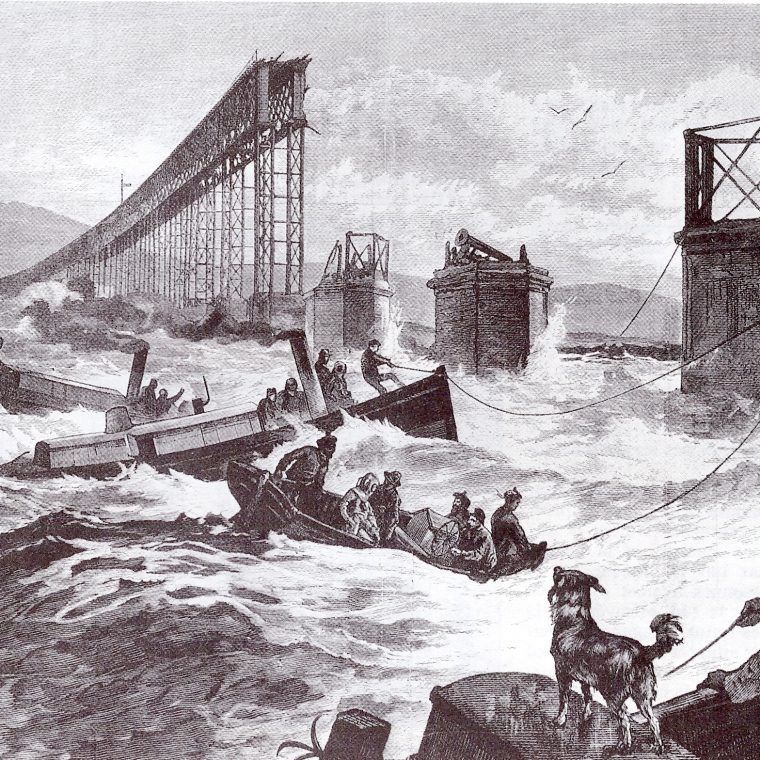
- The Firth of Tay Bridge collapse of 1879 in Scotland, which focussed engineers on wind pressure on bridges and on the unsuitability of cast iron for dynamic loading. The illustration above is from the contemporary press coverage.
- The Triangle Fire of 1911 in New York, which focussed designers and regulators on egress as a primary life-safety requirement.
- The Ronan Point apartment house partial collapse of 1968 in London, which focussed engineers on progressive collapse and resiliency.
- The World Trade Center 1 and 2 collapses of 2001 in New York, which focussed engineers on progressive collapse and resiliency. Again.