
Some recent reading on the role of standards in engineering design will be showing up here, but I wanted to introduce the topic of standardization on the macro level.
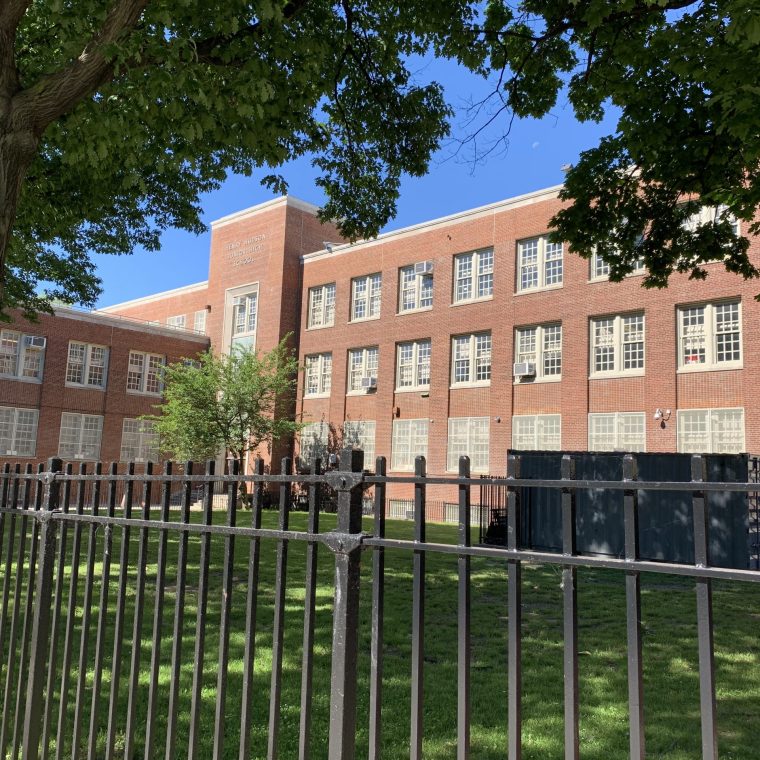
The picture above, for the east Bronx, is a public elementary school. To any alumnus of the New York City public school system, like me, it is instantly recognizable as such. There are a hundred architectural details, ranging from the basic floor plan to the window surrounds, that declare it to be an NYC public school. But the resemblance is actually deeper than that: this buiilding is a near twin to the school I attended in Queens 1970- to 1973. If I didn’t know where the picture was taken – if I had not taken it myself – I could be fooled into thinking that this was a completely different building. In short, there are standardized building types within the school system, and it’s not very difficult to find twins and near-twins.
That shouldn’t be very surprising. There are some 1100 purpose-built school buildings in the system, and there are not 1100 different architectural programs for them. I’m not sure there are a twenty different architectural programs needed for the school system: the pedagogical requirements of a school in the Bronx are the same as those in Queens, districts are approximately the same size so the school size should be fairly consistent, external issues (such as weather) are obviously the same, and so on.
There are several distinct eras of design in the city’s public school history, and there are groups of similar or identical buildings within each era. Architects (and to some degree, engineers) like the idea of a “kit of parts,” of reusable elements (on the scale of building design, rather than the scale of, say, door jambs) that can be assembled in different combinations to create multiple designs from a limited palette. I’m neutral to that idea: I see nothing particularly wrong with it, but I also see nothing particularly to recommend it. In the case of these school buildings, there are absolutely repeated design elements even in non-identical buildings (there is nothing more recognizable to someone who went to an NYC school than the auditorium), but there is also repetition on a large scale.
It is not very difficult to find groups of identical buildings anywhere in the world, from rowhouses to tenements to factories. Such groups are not usually held up as examples of standardization, but that is (from one perceptive) exactly what they are. An architectural design problem has been solved once, and the easiest way to replicate that success of that solution is to replicate the design. You also, of course, replicate the design’s shortcomings, which is why copying designs blindly is not a good idea.