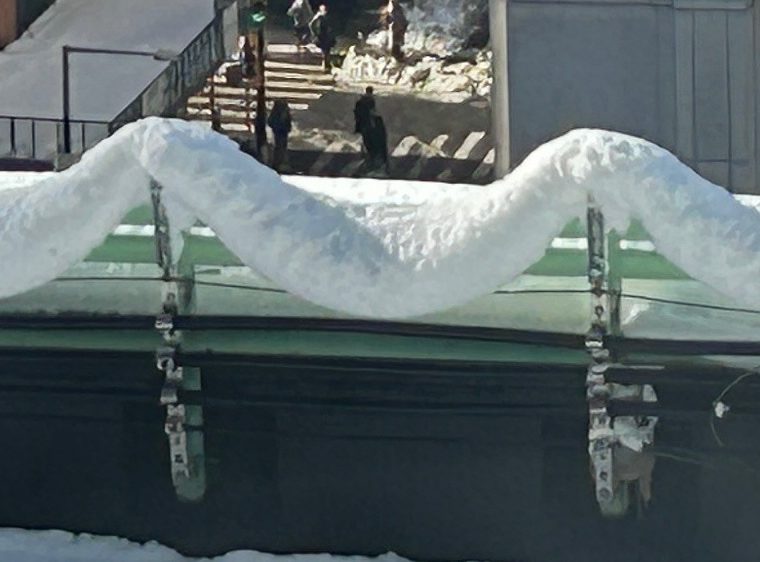

Friend of the blog and friend of OSE Nancy Rankin sent this photo, taken out her office window:

So we’re all clear: this is a narrow setback roof on the building she’s in, facing the street beyond. Her question1 to me, accompanying the photo was “Tensile strength of snow?” Unfortunately, the answer is “meh.”
It’s probably not obvious, so what you’re looking at is a low parapet that has been extended upwards through the use of a handrail fastened to the parapet interior face. If you look at the far right, where the snow is sparse, you can see it: there are silver2 metal uprights fastened to the black3 inside face of the parapet, supporting two green4 rails. A lot of setbacks roofs from the 1920s and 30s that were never meant to be occupied (and some that were) have dangerously low parapets. Code safety height for a parapet or handrail now is 42 inches, but I’ve seen 12 inch parapets. So the apparently tacked-railing might be simply to get a safety handrail for maintenance workers. Anyway…
In addition to some 18 inches of snow, there was a lot of wind yesterday, pushing the snow around. That weird roll of snow on the roof is, for example, an artifact of the wind. It looks like the snow fell on the handrail in a draped garland shape, but that’s probably not quite right. It seems to have fallen supported by the upper surfaces: the top rail and the tops of the uprights, and then partially slid off the top rail, in towards the setback facade where Nancy’s window is. And that’s where the tensile strength of snow enters the picture. If the snow is supported by the top rail but is mostly hanging off the inside face, then (a) there’s a net torque inwards from the eccentric snow weight, resisted by the friction (and maybe some adhesion) between the snow and the rail surface, and (b) the snow that is not directly supported by the rail is supported by the snow that is via cohesion, in this case specifically in tension.
We’re not talking about a lot of snow here. At a guess5, we’re looking at a hanging snow volume that is maybe 2 feet long (along the garland curve), maybe 8 inches high, and maybe 6 to 8 inches eccentric to the rail. So the volume is maybe 0.9 or 1 cubic foot, and the tension (and/or shear, depending on how you look at it) is distributed over an area of about 1.3 square feet. Snow weight varies, but this is very much not packed down, so using a middle-range value of 25 pcf, the weight of that garland is 25 pounds or less, and the tension across the interface is about 19 psf6 or about 0.14 psi. Amazingly, someone has tabulated the tensile strength of snow, and again using the middle value, it’s 0.36 psi. So that snow has a safety factor of about 2 in not tearing off. I’ll find out later, but my guess is that as it warmed up, the garland failed by rotating inward (torsional shear failure) rather than ripping (tensile failure).
In case you’re wondering, snow’s compressive strength is about 1000 times its tensile strength. And since shear is just diagonal tension, the compressive strength is about 1000 times the shear strength. Which explains why a skier so easily sheds snow to the side (shearing it) but doesn’t sink in.
If you’re wondering about the title, behold this masterpiece: Contextual Analysis.
- Nancy’s question was interesting. The silliness of my response is my responsibility, not hers. ↩︎
- Probably galvanized steel. Looks like Unistrut. ↩︎
- Roofing of some kind. If it’s original to that 1920s building, it may very well be tar paper. ↩︎
- Painted steel? Fiberglass? Your guess is as good as mine. ↩︎
- One of the weirder classes I took in school, Engineering Modeling and Design, focussed a surprising amount on this kind of guess. ↩︎
- And I’m going to use 20 psf because I really only have one significant figure here. ↩︎

You must be logged in to post a comment.