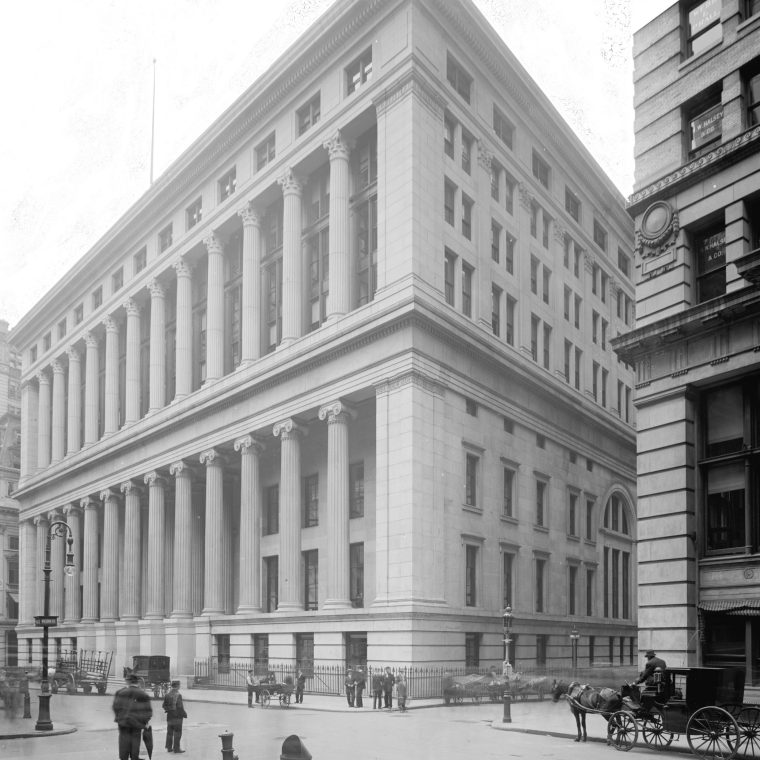

55 Wall Street is an impressive building and always has been. It was constructed, between 1836 and 1842, in the days when masonry construction had to pause for cold weather, as the Merchants Exchange. The start date gives a hint as to what happened: the old Merchants Exchange burned in the Great Fire of 1835. The replacement was built with all-masonry construction, meaning masonry vaulted floors, to be fireproof. It also briefly housed the New York Stock Exchange and was converted in 1862 to the New York Customs House. Work on a new Customs House at Bowling Green started shortly after 1900 and was completed in 1907; the National City Bank (before twentieth-century branding converted it to CitiBank) had bought the building in 1899 but didn’t move in until 1908.
But discussing the occupants misses the biggest point: the building that you see above, in a circa 1908 photo, is not the one that was built in the 1830s. The Merchants Exchange was the first four stories of the building you see, up to the big water-table that separates the lower colonnade from the upper colonnade. The central atrium of the building was topped by a large dome, which projected above the roof and was visible from some distance. A partial fifth floor was added later on, partially obscuring the dome. National City Bank wanted a bigger building for its headquarters, and after the Customs House moved out in 1907, the old fifth floor and dome were removed, and four more stories were added. So the building as it stands is almost exactly twice the original in size.
There are some subtle hints about the history. Isiah Rogers designed the original building in the Greek Revival style popular in New York in the early 1800s. That style, like all classical styles, favors symmetry, and the mismatch between the upper and lower windows on the right side (William Street) facade would be quite odd if it was all original. The facade behind the upper colonnade is quite open and glassy for an 1830s masonry building, while that behind the lower colonnade is the expected heavy wall with small windows. The columns in the lower colonnade are in the Ionic order, while those in the upper colonnade are Corinthian; mixing orders was a Roman innovation and not normally seen in Greek Revival (or Greek) classical designs. McKim, Mead & White, the architects for the addition, were also classicists, but preferred Roman models. The addition is also steel-framed father than using vaulted floors, reflecting the changes in structural technology of the 70 years between the two building campaigns. But MM&W’s skill can be seen in the fact that most people looking at the building today never realize it’s twice as tall as it once was.

