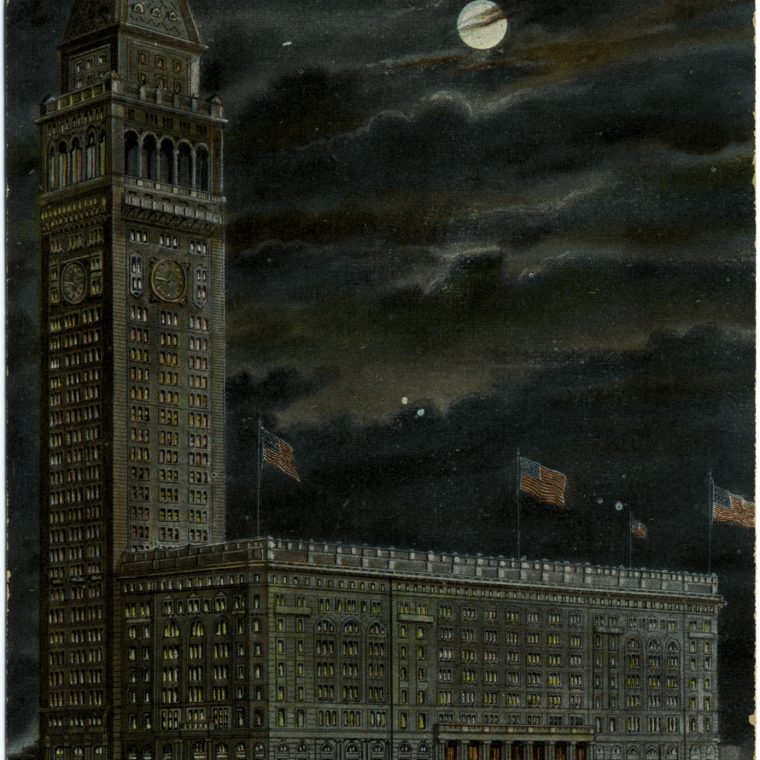

Postcards showing touristy views of US cities have been around since the late 1800s. Today’s postcards are mostly photographs and therefore, within the limits of easy photo-manipulation, reasonably accurate. The cards from 100 or 120 years ago, not so much. They were painted or drawn, often from photographs, for easier reproduction and the subject of the card was emphasized at the expense of reality. The picture above is a good example. It shows the Met Life tower at Madison Avenue and 24th Street and the older Met Life buildings adjacent. If Met Life was the tallest building in the world, then this postcard was made between 1909 (when Met Life was competed and took the title from the Singer Building) and 1912 (when Woolworth was completed). In any case, the Met Life complex seems to be sitting alone in splendid isolation. This angle is not possible now – and was not in 1909 – because to get it would require all of the buildings on the south side of 23rd Street to disappear…including the 1903 Flatiron Building.
Similarly, where did the rest of Times Square disappear to in this view of the 1904 New York Times Building?

Here’s an impressionistic view of Woolworth from 1916, with the old General Post Office looming larger than it actually was, off to the left:

Here’s a still-vaguely-impressionistic but more accurate view of City Hall Park and the surrounding skyscrapers. From the left: the World Building with lights on is dome, the Tribune Building, the old New York Times Building, the Park Row Building with the crown of Singer peeking over its top, the bulk of the Hudson Terminal Building in the distance behind the Post Office, Woolworth, the bizarre little Shoe and Leather Bank, Postal Telegraph, and the hip-roofed Home Life Insurance. City Hall is in the foreground center and the Tweed Courthouse in the lower right corner.

But my favorite example of erasing reality is shown in the next three postcards. First, the Singer Building, with its 41 stories somehow turned into 41 stairs:

Next, the City Investing Building:

Obviously the street widths are exaggerated in both of those views. Lower Manhattan’s streets are narrow, as befits a seventeenth-century Dutch village, to the point where they were frequently described as “canyons” in the same period when these postcards were made. But that’s not the real problem with these two postcards. The real problem is the Singer and City Investing were not just on the same block, they were immediately adjacent to one another. Here’s a postcard with an honest view of the two of them (Singer in front, City Investing behind):
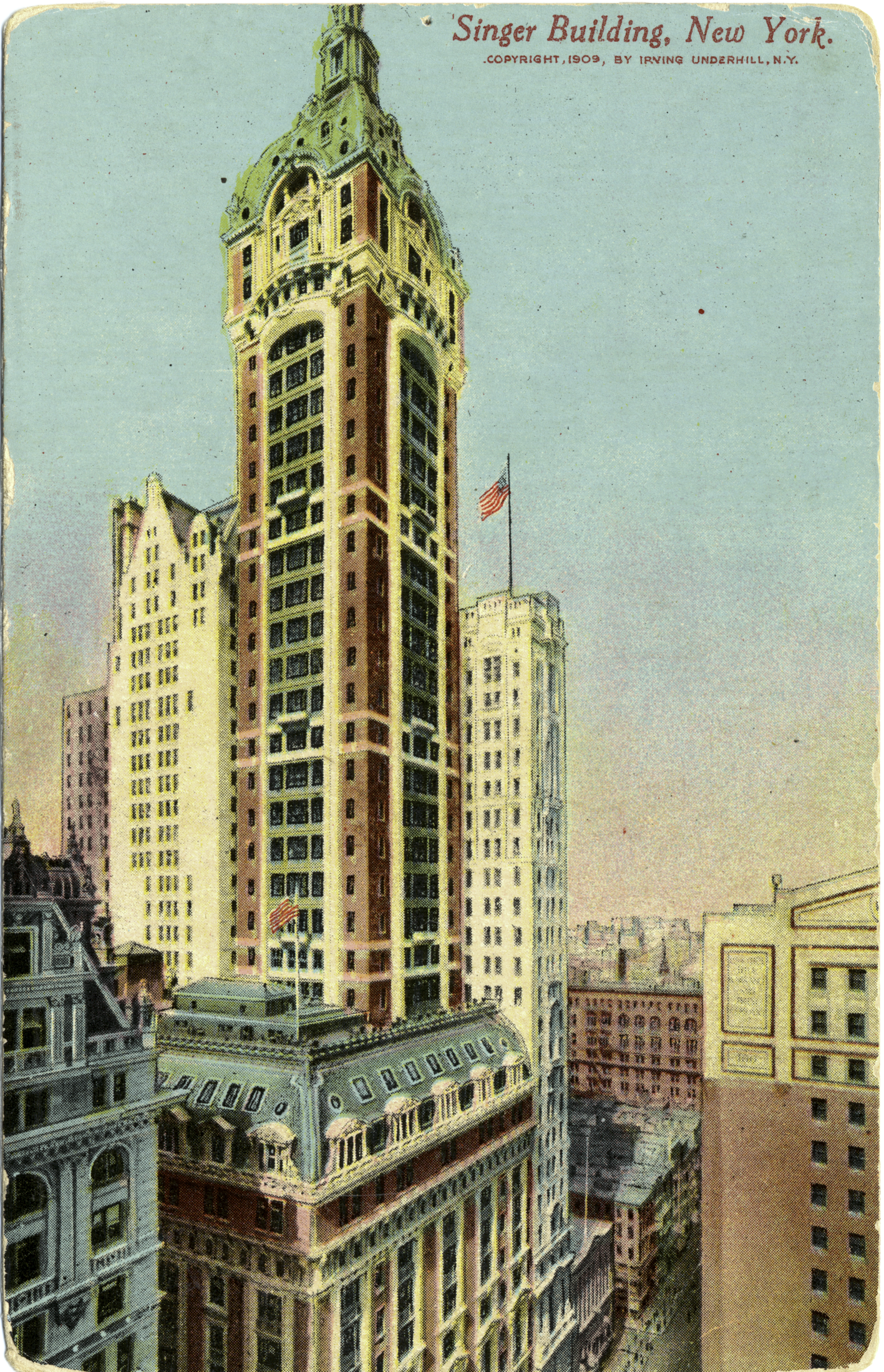
Note that the last, accurate view, is from Irving Underhill, a photographer. This is heavily retouched – Underhill shot in black and white, for example – but at least started from a real view.
Believing your eyes doesn’t necessarily mean believing every picture you see.
You must be logged in to post a comment.