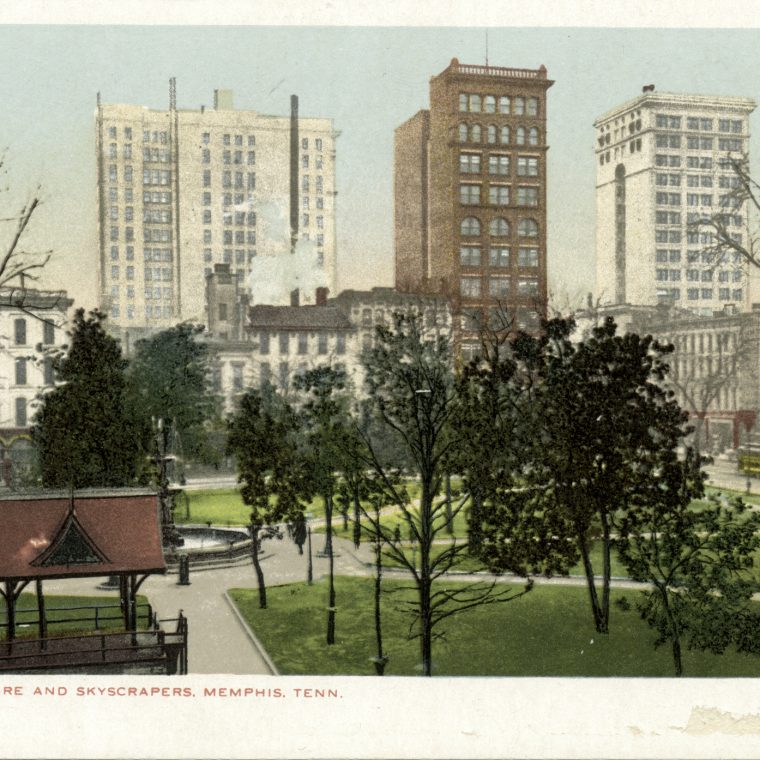

The postcard above, a 1906 painting based on the Detroit Publishing Company photo below, started two completely unrelated trains of thought.
First, as I discovered while doing the research that led to The Structure of Skyscrapers, an interesting thing happened starting around 1895. The cat was out of the bag on the technology behind steel-frame skyscrapers, which had been developed mostly in Chicago and New York. Once it was established what was needed – a complete steel frame designed for all gravity and wind loads on the building, some form of fireproof floor, and an exterior masonry wall detailed so that it was fully supported by the frame – people started constructing this kind of building all over the country. Before 1900 there were a number of cities with literally one skyscraper – Grand Rapids, Providence, Omaha, and Duluth, for example. Memphis was a one-skyscraper city: the building in the center with the flagpole, the Dr. D. T. Porter Building of 1895. Because the new technology was relatively easy for engineers with a bridge-design background and architects with any significant background in tall masonry-walled structures, it spread rapidly. It democratized: anyone could build a skyscraper if they knew the basics and had funding.
Second, all three tall buildings in the picture had ornate street facades and plain side walls. That was the way most buildings of that era were designed, but with early skyscrapers, and particularly with those not surrounded by a lot of other tall buildings, like the three here, it meant that the contrast between the sides and the front was visible. The architectural statement of the front facade is, to my eyes at least, undercut by seeing the blank side walls. I feel like I’m supposed to have blinders on, forcing me to look at only one side of the building. The solution was to design all sides of tall buildings to be seen, but that took some time to get going and even today isn’t always done.


You must be logged in to post a comment.