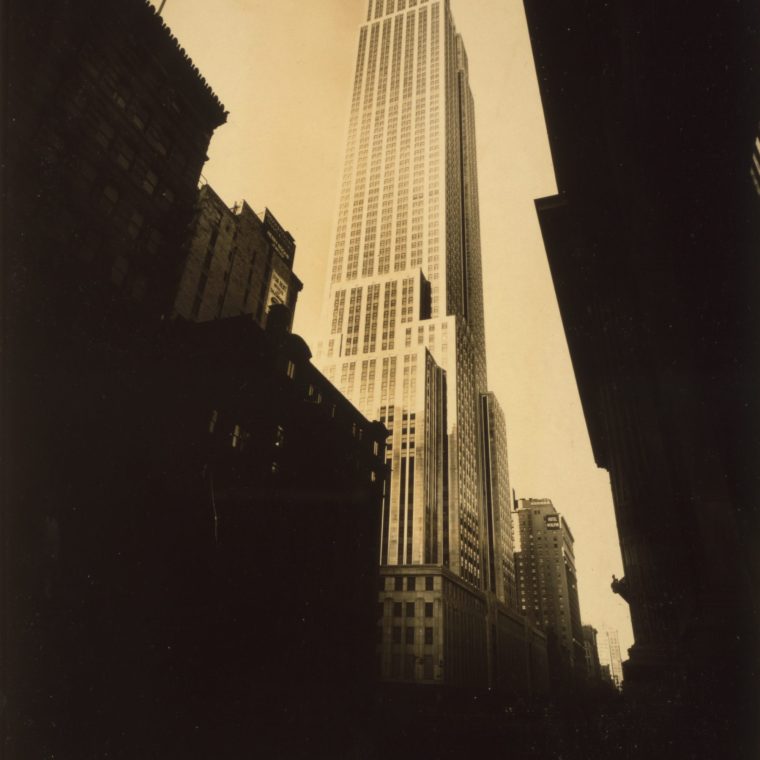

Irving Underhill‘s 1931 picture of the Empire State Building is worth a look solely as a formal composition. In my opinion, that’s as good a photo as you’ll see of the building, even if it’s not very informative. The original is (depending on how you crop the processing marks at the edges) about 2700 x 3500 pixels, which is a little low for me to blow up for a wall poster in the office, but doable.
Putting aside the photographer’s artistry, the photo also shows an interesting side-effect of Manhattan’s grid: it can very difficult to get head-on photos of our tall buildings. Except for Broadway, we have no diagonal streets of any appreciable length in the grid. (A side note here, for non-NYers: the easiest way to think of midtown versus downtown is to think “new town” versus “old town” as in Edinburgh, Barcelona , or any number of other medieval European cities that got an early-modern street expansion. Downtown New York is the original Dutch colony plus landfill, and then the English colonial and early-republic extensions northward. Midtown starts about a mile and half north of Houston Street, where the numbered grid begins, and extends up to Central Park, where Uptown starts.) A few lucky buildings (the Flatiron and the old Times building most obviously) are properly visible from multiple angles because of Broadway’s diagonal intersection with the main avenues; somewhat more, but still few, are clearly visible because they are opposite parks or plazas, with Woolworth and 30 Rock as the most obvious examples.
Most New York high-rises are clearly visible from a distance, particularly from the upper floors of other high-rises, but not up close. Using the Empire State as an example, where can you stand to get a clear close-up view? Fifth Avenue and 34th Street are both wide, but are aligned with edges of the building’s lot, so the best you can do is to stand maybe a block or two away on the opposite side of the street and get a diagonal angle. Underhill’s photo is exactly that, looking diagonally down 34th Street from a couple of hundred feet to the east. As you can see, other buildings crowd the view. The view from 33rd Street is similar but worse, as it’s half the width of 34th. If you stand close to the ESB, the entire top of the building disappears from view because of the setbacks, leaving you with a great photo of the five-story base. (Note that this is specifically the intent of the 1916 zoning law: the setbacks increase daylight at the street level by making the building tops disappear when you’re close.)
So Underhill’s art is art, but he also (possibly inadvertently) showed how street-layout choices affect views.