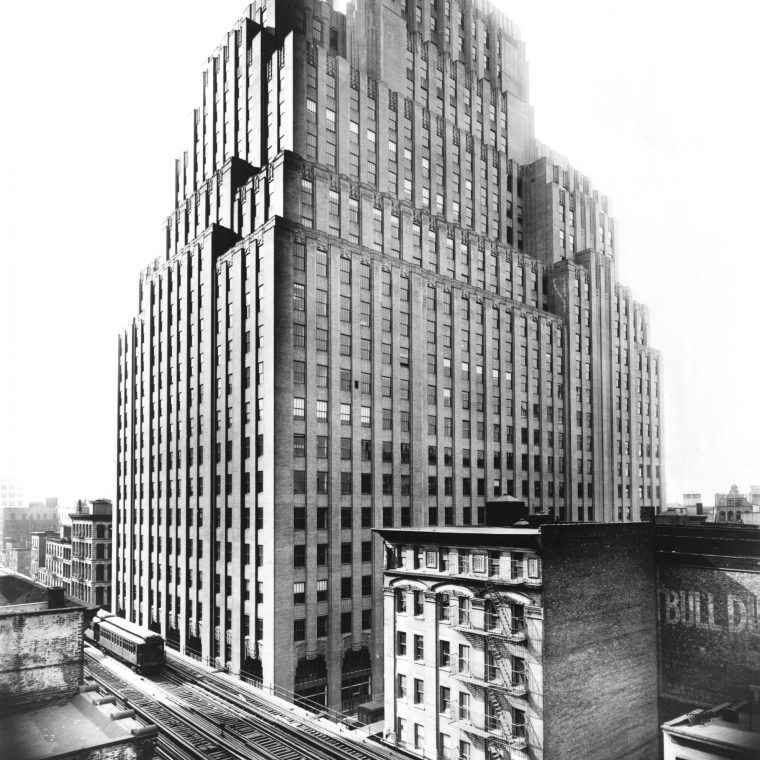

Underhill again, with the Western Union Telegraph Building around 1931, or when the building was maybe a year old. I mentioned briefly that the building’s architect, Ralph Walker, liked designing mountains. This building, now known as 60 Hudson Street, is where he got it exactly right.
The building served two purposes: a shell of office space for Western Union around a windowless core of communications equipment. Even though WU moved on almost fifty years ago, this is still true, with various forms of more modern telecoms housed there. Structurally, it’s a fairly ordinary steel-frame building of its time, although deigned for heavier-than-normal loads. Architecturally, Walker played a game that was in vogue at the time, using many slight variations of brick color to shade the building from dark at its base to light at its top. That shading creates a minor optical illusion that the sun is shining on the building even when it’s not, which helps the mountain-like appearance.
I find the picture interesting for the way it shows the contrast between modern twentieth-century New York and the enduring cityscape of the past. For example, the Sixth Avenue elevated over West Broadway*, a modern marvel in 1878, looks like a toy train next to 60 Hudson. The loft building to the right (with the fire escape) is a pretty good representative of the 1880s in Manhattan, while the small building at the lower right corner looks to be twenty or thirty years older than that. The painted billboard on the right – placed solely for the attention of people riding the el – is for Bull Durham, even though the era of spittoons being a regular part of bar furniture had passed.
As I’ve said before, a feature of almost every place is that multiple times are represented in the built environment. We think of 1930s New York in terms of buildings like this, but it was also full of older buildings, as is 2020s New York. The new buildings at any moment are a small percentage of the total, but they provide contrast to the past.
* This touches on one of the most annoying and confusing details of New York’s confusing and annoying street layout. “West Broadway” in most places in the US would be the western half of the length of a street named Broadway. Here, West Broadway, Broadway, and East Broadway are three separate streets. West Broadway is just about parallel to Broadway, and two to four blocks west of it, from Vesey Street to Washington Square; East Broadway runs at a about a 45 degree angle, parallel to the Lower East Side’s bulge to the east of Manhattan’s regular eastern edge.