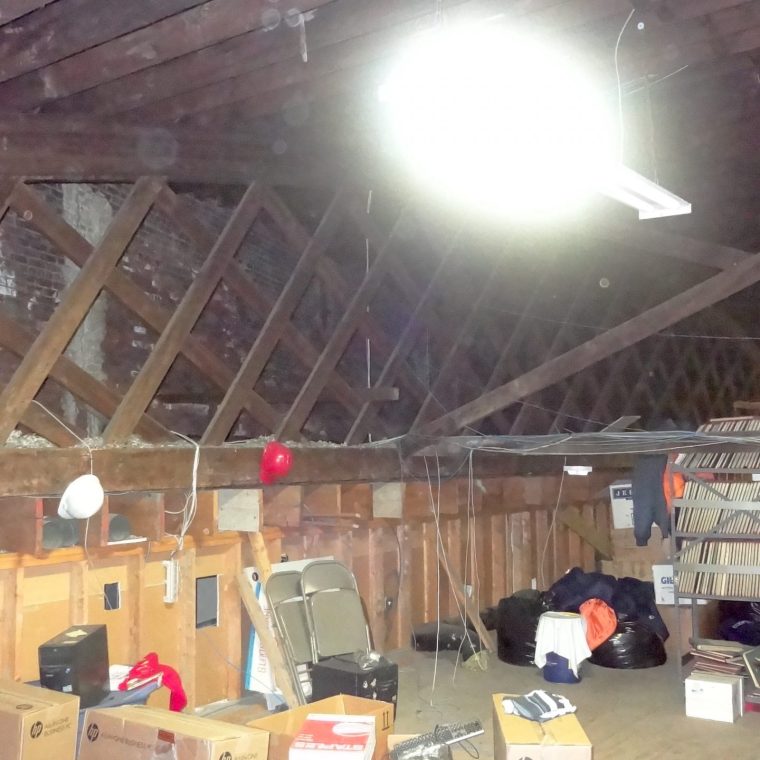

I’ll be writing a few posts shortly on bowstring-truss roofs. A few years ago, we analyzed several of those structures and I happened to be walking by one during demolition recently and took a picture (which will be here real soon now). The somewhat impressionistic photo above shows a bowstring-truss roof that we investigated. But before I dive into that topic, there’s a concept that needs some exploration, and that’s “fail safe.” Pretty much everyone has heard that phrase, but I’m not sure everyone knows what it means. A fail safe isn’t a back-up or a plan B, it’s a way of thinking about design. It is, specifically, designing a thing so that when it fails, it fails in a safe manner.
Some examples probably will help. Elisha Otis’s great invention in the 1850s was a way to make elevators fail safe. Instead of mounting the hoisting cable to the top of the cab, which is the logical thing to do, he mounted a leaf spring on top of the cab and attached the cable to the spring. During normal operation, the weight of the cab pulling down was enough to keep the ends of the spring within the footprint of the cab. If the cable broke, the tension in the spring would be released, and the ends of the spring would push out past the cab sides and engage toothed racks on the sides of the shaft. If the worst thing that could happen to an elevator happened – if the cable failed – the cab was safe. Another example is the use of automatically closing fire doors. Modern fire doors in the middle of a hallway have spring closers but are held open by electromagnets; if the power fails, the magnets shut off and the springs shut the doors. There’s a nineteenth century version of the same idea where the doors run on a sloped track, so that they would close if not held open by a weight that is suspended on a hemp rope running past a pulley. If the rope burns through, the door slides shut. Fire doors are considered to be in their safe position when closed, so both the old and new versions fail safe.
Bowstring trusses are widely considered to be dangerous by fire-fighters, for several reasons. One of them is that they don’t fail safe compared to some other truss forms. (I should point out that fire-fighters aren’t very happy about any form of truss roof, but they particularly dislike bowstring trusses.) If a simple truss with more or less parallel top and bottom chords, like yesterday’s roof, fails in a fire, it will fail like a beam. That is, it will bend down in the middle and fall into the space below. If it is very tightly fastened to masonry walls at either end it might cause some damage, but it doesn’t necessarily push or pull on those walls. In a fire, a likely form of failure would be the bottom chord burning (for wood trusses) or losing strength (for steel trusses). The bottom chord is closest to the floor (and fire) below and generally exposed. Here’s an illustration that Ryan Cleary, the OSE engineer who performed most of our bowstring-truss investigations, created of the truss in the photo above:

The bottom chord is in tension, as is true of every simple truss, but it’s more specifically a tension tie for the top arch. If the bottom chord burns through, the top chord is now an arch with nothing to offset its end thrust. When if fails – which it will immediately on losing the bottom chord – it will push outward on the walls at each end. Given that it’s a shallow arch, the horizontal component of the thrust will be considerable, and likely to cause outward collapse of part of the wall. It fails not safe. There are good reasons why bowstring trusses of this kind were popular in the early and middle decades of the twentieth century, but the outward thrust in failure is by itself enough of a reason to be suspicious of them.

You must be logged in to post a comment.