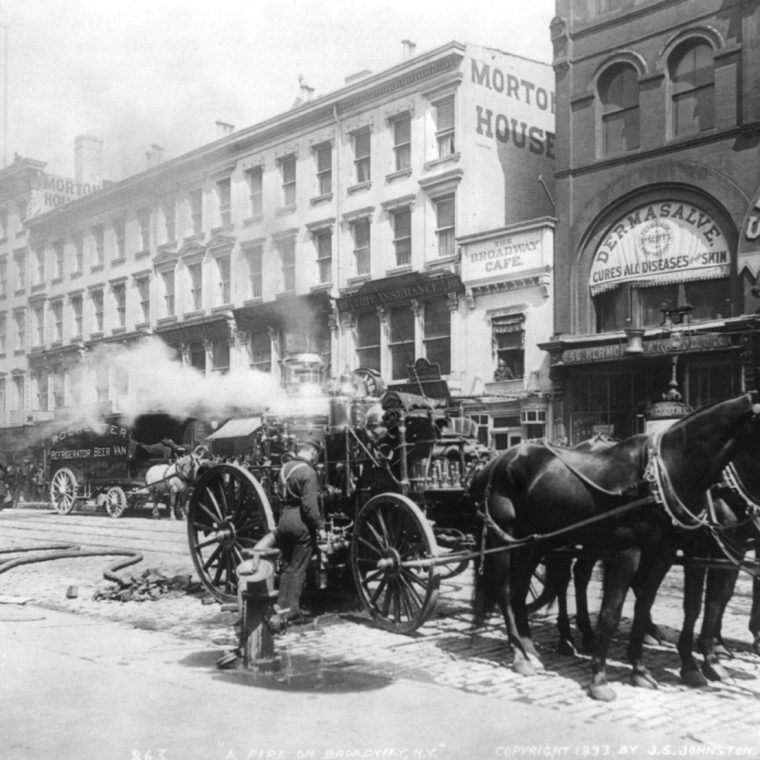

The title of that photo is “A fire on Broadway, N.Y.” but no fire is visible. The steam engine that works the pump is running – the black smoke and white steam coming out of the pump makes that clear – and a full hose is lying on the ground between the pump and the watching policeman. I’d guess that the fire is on the same side of the street we’re on, off frame to the left. Note also the person looking our way from the second-story window above the Broadway Cafe.
The picture was taken in 1893, but most of what we’re seeing is older. The part of New York around Union Square was built up in the middle of the nineteenth century, and wasn’t significantly redeveloped until the 1900s. So while the details of ephemeral objects – the policeman’s uniform, the fire engine, the clothing of the men in the background, and the products advertised – are current to 1893, the buildings reflect an older past. Here’s a map of the area:

And here’s the block we’re looking at:

There’s no great theme to what’s in the photo, so here are some random observations:
- The Union Square Theater’s building and the Morton House hotel were apparently owned by the same man, and they had a weird spatial relationship. Photos of 14th Street show the Morton House east of the theater entrance (facing Fourth Avenue on the far right of the close-up map) and the photo above shows it also west of the theater, facing Broadway. Operating a hotel in two disjointed halves seems like a problem, making me wonder if the halves were somehow connected through the theater building, perhaps at the second floor level. The theater auditorium was in the center of the block, where its name is printed.
- The Star Theater, built as Wallach’s Theater in the 1860s, was the subject of an early stop-motion movie. Its demolition in 1902 can be seen here.
- The diagonal blue lines in the close-up map indicate land boundaries that pre-date the numbered street grid, mostly from the eighteenth century. If you look at the large map, you can get a sense of the old farms and also long-gone rural roads: Union Road, Skinner’s Road, and Sandy Hill Road. Part of the latter remains as Astor Place. The tiny building at 848 Broadway with the Broadway Cafe – 10 feet, 3 inches wide – is the result of some ancient cartography.
- I can’t say for certain that Dr. Scott’s Dermasalve was definitely snake oil, but the fact that it was necessary to put “THERE ARE NO POISONS IN IT” in the ads is not a hopeful sign.

- Note the address for Dr. Scott, doing business as “The Challenge Chemical Company,” is 842 Broadway, which is the Star Theater. A lot of old theaters had rental space wrapped around their auditoriums and over their lobbies, as I’m suggesting the Morton House may have been related to the Union Square Theater.
- I suspect that the “Rochester Refrigerator Beer Van” was an ice box on wheels for delivering cold beer to where it was needed, like hotels. Mechanical refrigeration had been invented well before 1893, but it was bulky and fragile, and there’s no sign that van has any such equipment inside.

You must be logged in to post a comment.