
One last thought about curved structure: everything I’ve said before is loaded with hidden assumptions, but I don’t feel too bad about that because so is everything that everyone else has to say. There’s a problem inherent in any narrative description that engineers don’t consciously think about very often because it strays into territory far from our comfort zone: all words are vague because they are attempting to capture a piece of the actual world using a single concept. I am perhaps overly sensitive to this issue because of the time I spent wrestling with the meaning of “skyscraper.” Skyscraper is a made-up word* that means something like “a building that I think is tall.” Its meaning has changed over time and differs from one person to another. That’s a good example that doesn’t bother anyone too much, as the problem with it is reasonably well known. Here’s a more difficult example: what’s the difference between a beam and an arch?
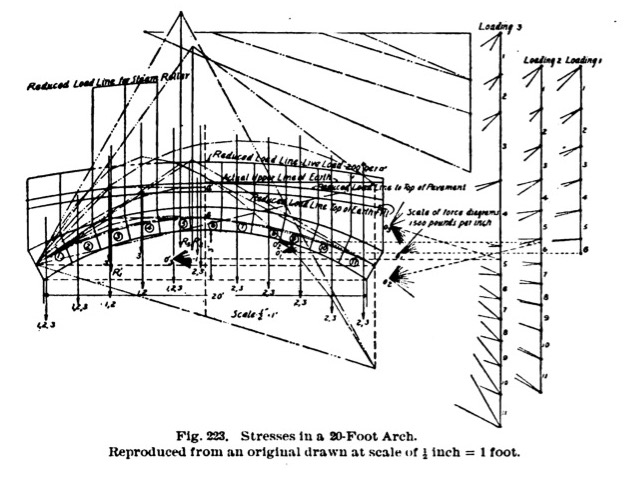
Most definitions of “beam” either imply or explicitly state that an ordinary beam is straight. There’s no engineering reason that has to be true, as my example of the beams at Newark Penn Station showed. And, to be nit-picky**, very few beams actually are straight. Beams deflect under load and so leave their theoretical straightness behind for a fourth-degree curve, beams are manufactured not quite straight because construction is a real-world process and all of its geometry has tolerances, wood and concrete beams tend to creep*** over time, and many large beams are manufactured cambered (curved) upwards in order to reduce the effect of landing deflection. Any engineer will tell you that beams can be curved in a vertical plane, in a horizontal plane, or in three dimensons, but the canonical image of a beam is a straight line. Meanwhile, arches are thought of as curved**** because their structural action converts vertical gravity forces into a horizontal span. That rather crowded diagram above shows a graphic-statics solution for an arch, as was popular before the use of computers in analysis, and the core concept is looking at the forces acting on each block of masonry in the arch. A block to the right of the center of the arch receives a push from the block to its left side, down and to the right, and adds to that its own weight and whatever forces are applied to it from above, increasing both the rightward and downward push. That thrust gets bigger with each block. The two-dimensional nature of the thrust lends itself to a two-dimensional shape, such as an arc. But flat arches work just fine and can look quite beamlike.
The best way to differentiate beams from arches is to look at structural action: a beam carries its load in flexure, while an arch carries its load in compression. But even that can get a little blurry: here’s another example of a cast-iron (compression) arch tied with a wrought-iron (tension) rod, acting as a lintel. There’s little functional difference between such a lintel and a beam. If you want to get even more nit-picky*****, the tied arch lintel has no shear transfer of load between the compression and tension except at the ends, and that shear transfer is part of the ordinary force diagram of a beam.
Rather than setting up a bunch of targets****** just to knock them down, why not make a simple statement: all structures and all structural members have a continuum of stresses within them, and our models are simplifications created to allow for fast analysis. When we call something a “beam” we know the formula to use to analyze it; when we call it an “arch” we know to use a different formula. Neither is perfectly accurate, and it’s possible to come up with examples where both can apply equally well (or equally badly). Depending on the degree of curvature, it may be possible to use the ordinary formula designed for a straight beam, so that the use of curved beams at Newark Penn Station doesn’t mean that the beams were not analyzed in the ordinary manner. That implies we could be more adventurous in structural design – within the constraints of budget – without overanalyzing everything.
* Of course, as Thor pointed out in Avengers: Infinity War, all words are made up.
** Which is pretty much inevitable in this type of discussion.
*** That is, undergo continuing sag under static load.
**** And most are curved.
***** Why not?
****** They’re not strawmen, since they represent real engineering concepts.