
I’d be hard pressed to think of a less realistic movie than this, and I include fantasy when I say that. On the other hand, I enjoyed it, so who cares? When gross violations of the square-cube law are the least of the twenty or so serious problems with physics and biology, you have to simply suspend disbelief or not watch.
We get the destruction of the Golden Gate Bridge by a huge monster (a Kaiju) before the opening credits. Unlike the scene in Godzilla, this was not bad: the deck seemed properly flexible as the huge force exerted on one side ripped it apart.
My first real engineering question concerns the big wall that’s being built, supposedly to contain the Kaiju to the Pacific. First, unless it continues across the Bering Strait, across the many, many straits in Indonesia, between Indonesia and the asian mainland, between Indonesian and Australia, between Australia and Antarctica, and between Cape Horn and Antartica, it’s not going to do its job. (The one place we see the wall close up is in Alaska, and we hear about a portion of it in Sydney, so its global scale is well established.) The Kaiju can swim, so a wall would have to run from the seabed to the visible height of hundreds of feet above sea level; cutting off the Pacific in that manner would, of course, be far deadlier to life on Earth than the monsters. So, perhaps, it is a construction project that should not be approved by the local building authorities.
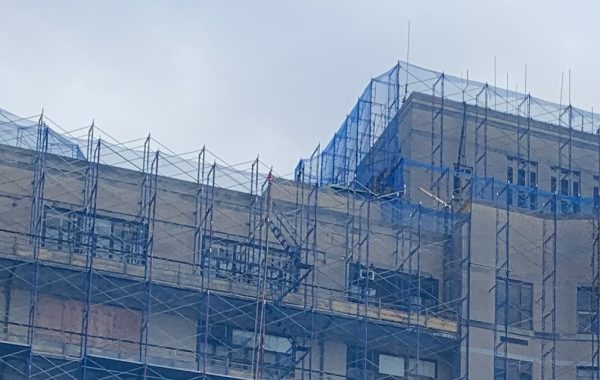
Where we see the wall under construction, what we see is a huge 3D Cartesian grid of steel, presumably with a steel face. That seems like a mistake. The amount of material required for the thousands of miles of wall (my rough guess is about 28,000 miles) is unrealistic in any circumstance, but it seems like less work to build a huge concrete wall than to fabricate all that steel. It seems like even less work too build a huge berm – perhaps using our endless supply of garbage – but that would be visually less impressive. Perhaps a garbage berm with a steel facing?
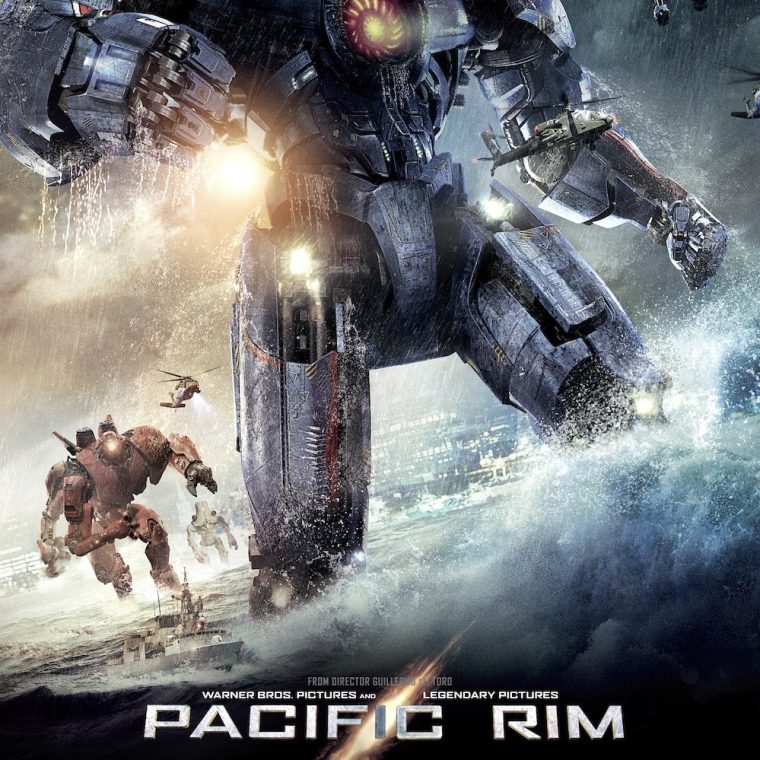
The other interesting question is the resilience of the giant humanoid tanks (Jaegers) that are used to fight the Kaiju. We see Jaegers repeatedly being knocked into more ordinary structures – buildings, ships, shipping containers – and not being damaged. Basically, any time a Jaeger hits something other than a Kaiju, the Jaeger dents or breaks the other thing. (See the third law of cartoon physics.) The only way that makes sense is if the Jaegers are much denser than the ordinary structures. That’s certainly possible, as buildings and ships are, statistically speaking, mostly open air. But if the interior of the Jaegers is solid-packed metal they would be quite extraordinarily heavy. Steel, for example, weighs about 490 pounds per cubic foot; there’s a reference to titanium at one point, which only weighs 280 pcf. The average person weights around 165 pounds at a tissue density just slightly more than water, around 63 pcf; if made of titanium, we’d average around 730 pounds; if scaled up to 300 feet high (my estimate of the Jaegers size) we’d weigh about 60,000 tons. The Jaegers’ feet are proportional to their human-shaped bodies, so the 16 or so square-inch average foot would be about 330 square feet – a New York studio apartment – so the pressure over the area of the foot during walking would be just about 300,000 psf. This is another example of the square-cube law, of course, but it tells me that the Jaegers would not be walking around on city streets because they’d be sinking into the ground.
Best, I think, to stick to enjoying the visual spectacle of metal giants battling giant monsters.