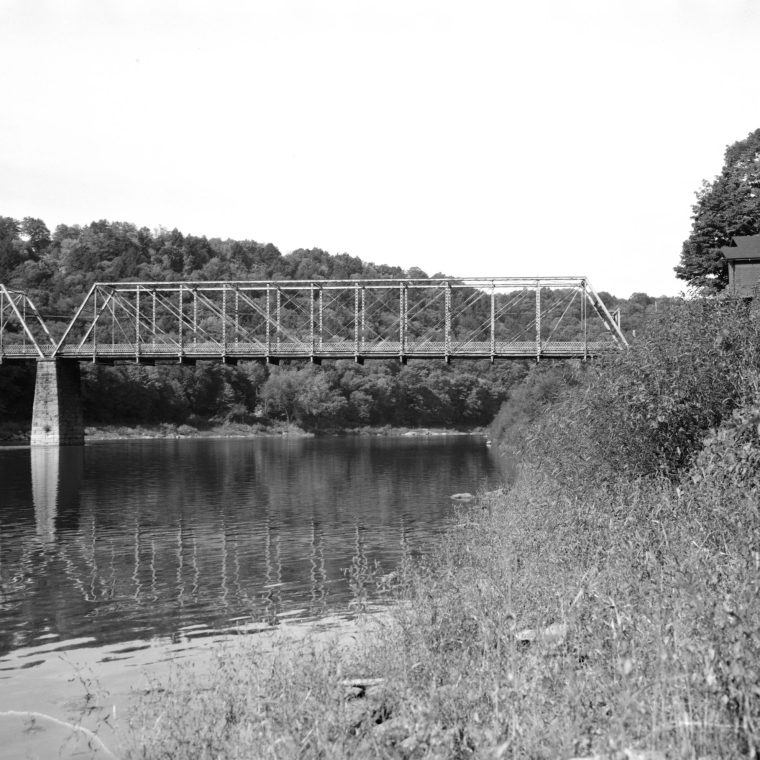

I haven’t looked at a bridge in a while, so here’s the Emlenton Bridge over the Allegheny River, about 60 miles upstream of Pittsburgh as the crow flies, but the topography of western Pennsylvania is such that travel on land between the town of Emlenton and Pittsburgh will cover a lot more ground than that.
The two main spans are double-intersection Pratt trusses, AKA Whipple trusses, built in 1883 in wrought iron.[efn_note]I have something of a love/hate relationship with Squire Whipple. He was undoubtedly one of the pioneers of engineered bridges in the US, but I find his writing (including his descriptions of bridge-building) to be hard to follow and his insistence on credit to be over-reaching.[/efn_note] The profile above is a bit boring, but up close, this bridge is a beauty, in part because of how slender its various elements are and the small-scale detail of the built-up members.

At somme point, the small scale of the built-up members starts to look like lace to me. In this case, the beams between the top chords of the trusses that are part fo the wind bracing, and the very small diameter of the tension diagonals in the truss webs have that effect. Here’s a view of one end, showing the portal bracing and the end-panel diagonals (up close, the layers of paint make it a bit less dainty, although still very thin):

The original deck – probably wood – was replaced in the 1950s with steel grating, which has the effect of continuing the lace down from the trusses:

It occurs to me that this type of design has more resilience than it’s given credit for. Decades of poor maintenance gave truss bridges a bad reputation, but if we ignore that and simply look at the structure, there’s a lot of redundancy here. The secondary truss diagonals, put in (I suspect) to carry pattern loading without creating compression in the main diagonals, provide some back-up. If some of the top-chord wind-bracing were to stop working (if a connection broke, for example) there would still be bracing provided by the undamaged portions of the bracing. If one panel of a truss failed – the diagonal or the vertical broken, for example – the continuous bottom chord could span past that panel point. If the bottom chord broke at one point, it could cantilever past the panel points on either side of the break. In all of these cases, relying on the unintended structural mechanisms would likely lead to some excessive deflection, but the bridge would not simply fall. In any structural failure, what we want as designers is that it fails slowly enough and gently enough for (a) people to escape and (b) the remainder to be repairable. This bridge seems to meet those criteria.

You must be logged in to post a comment.