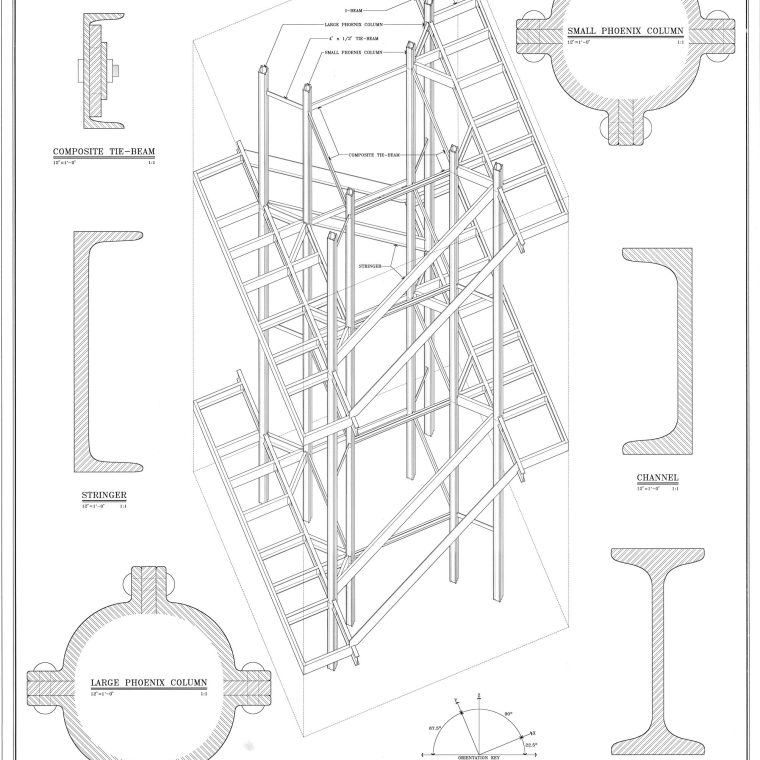

There was a well-known alternate in the 1880s and 90s to building up a square box column or a funny-looking scalloped one: the Phoenix Column. These columns, produced by the Phoenix Iron Works of Phoenixville, Pennsylvania, were nominally round in section. They were built up of circular arc segments with outward-projecting flanges; the segments were riveted together through the flanges. That may seem like the Chapman patent drawing in yesterday’s post, but the greatness of the Phoenix column was in the details. The riveted flanges provided a reliable and strong connection between the segments and also provided a place to attach beams. The HABS drawing above, of the Washington Monument, shows the interior stair, which was constructed in the 1870s and 80s and uses Phoenix columns as part of its design.
Here’s an example of a large Phoenix column:

The obvious question, looking at the Kellogg columns from yesterday and the Phoenix columns from today, is why one is superior to the other. It’s important to note that the differences can be small but still meaningful. Let’s start with loading. Given that these columns are radially symmetric (fancy engineering talk for “they look the same no matter how you turn your head”) there are really only three loads we need to discuss. There’s axial load (usually compression although they would work as well in tension), bending of the column as a whole (around any axis), and torsion around the longitudinal axis. The most common use of these sections, by far, was in locations where compression was expected to be the dominant or only load: compression struts in bridge trusses and columns in buildings with masonry walls carrying lateral load. The only bending in those uses would be small and accidental (connection eccentricity in the trusses, uneven live loading in the buildings) and may well have been ignored in the design. In those cases, there should also be effectively zero torsion.
I said yesterday that hollow circular and rectangular sections are good for columns specifically because of how that geometry helps with compressive load. Slender columns of any material have a tendency to buckle sideways when compressed. Engineers like simple solutions, so we deal with that buckling tendency by reducing the allow stress on columns when they get too slender, reducing their load-carrying capacity. Slenderness is today defined as the column length divided by the smallest radius of gyration (a fairly obscure geometric property of any shape); in the nineteenth century, the length of smallest side of the shape was often used instead of the radius of gyration. So to avoid the reduction-in-load penalty of slenderness a designer can decrease the length of the column or increase the radius of gyration.
If we’re talking about a column in a building or the compression chord in a truss, the column is braced where possible: at the floor levels in the building and at the panel points in the truss. So the length of the column is fixed. You can make the radius of gyration bigger by increasing the gross section size, but that’s another version of the same penalty we’re trying to avoid. (A bigger column means more metal, which means more cost, more weight to be dealt with during construction, and more overall weight to be carried by the structure.) But, based on the way that the radius of gyration is calculated, pushing the material from the center of the section to the outer edges increases the radius of gyration without increasing the weight. A wide-flange shape is better than a channel of the same weight, a hollow circle is better than a hollow rectangle of the same weight, and the Phoenix column, which has its non-flange weight as a circle, is better than a Kellogg column, which has its non flange weight as a scalloped circle. Phoenix columns are about as efficient – in the sense of reducing slenderness – as any shape could be made in wrought iron or steel in the nineteenth century. As steel itself became stronger after 1900, squeezing every last ounce of efficiency out of the shape became less important, and built-up square box shapes became more popular.

You must be logged in to post a comment.