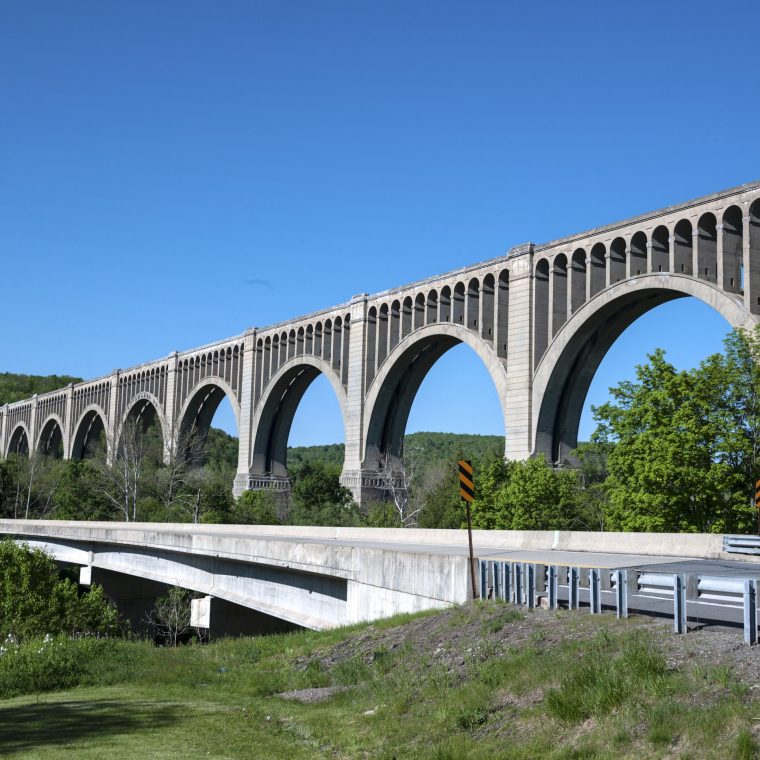

So after masonry, wood, iron, and steel viaducts, what’s left? The 1912 Tunkhannock Viaduct, above, constructed to eliminate a sloped and winding valley passage by the Delaware, Lackawanna and Western Railroad (AKA, the Lackawanna), is entirely concrete. It’s a spectacular structure in general, with ten 180-foot arch spans, and with the deck up to 240 feet above the valley of the Tunkhannock Creek. This viaduct is quite near the Starrucca Viaduct, which is no surprise given (a) the landforms of northeastern Pennsylvania and (b) the presence of railroad main lines there to carry coal to New York Harbor.
This is one of those bridges that looks good from any angle:

But if you look closely at the HAER photos, taken when it was 70 years old, wear is definitely visible:

The horizontal reveals in the surface serve no structural purpose and apparently were an attempt to imitate masonry. Similarly, the small upper arches, directly below the deck, are not necessary for a reinforced-concrete structure, but they keep the resemblance to masonry going.

The Lackawanna was one of the smaller railroads in the northeast, but it had capable engineers.


If railroad construction were still going on, we might see more viaducts like this, but the peak of construction was already past by the time this structure was built. New bridges were still built of course, partly to replace old ones and partly to deal with small changes in route alignment, but the era when a US railroad would build the largest concrete bridge in the world to straighten a line by less than four miles was done.
The era of grand railroad line construction went out on a high note. (The era of grand railroad station construction continued for a while longer.) From the steel-truss falsework, to the cable-conveyor concrete buckets, to the big arches, Tunkhannock was and is a spectacular structure.
The Tunkhannock viaduct, now in its eleventh decade in service, is still carrying freight trains.
You must be logged in to post a comment.